Accounting Internship Interview Questions
Audit and tax internships, including at the Big Four, usually ask a few technical basics next to the behavioral questions. Interviewers are not expecting a CPA's knowledge; they want to see that you understand the fundamentals from your classes and can explain them simply.
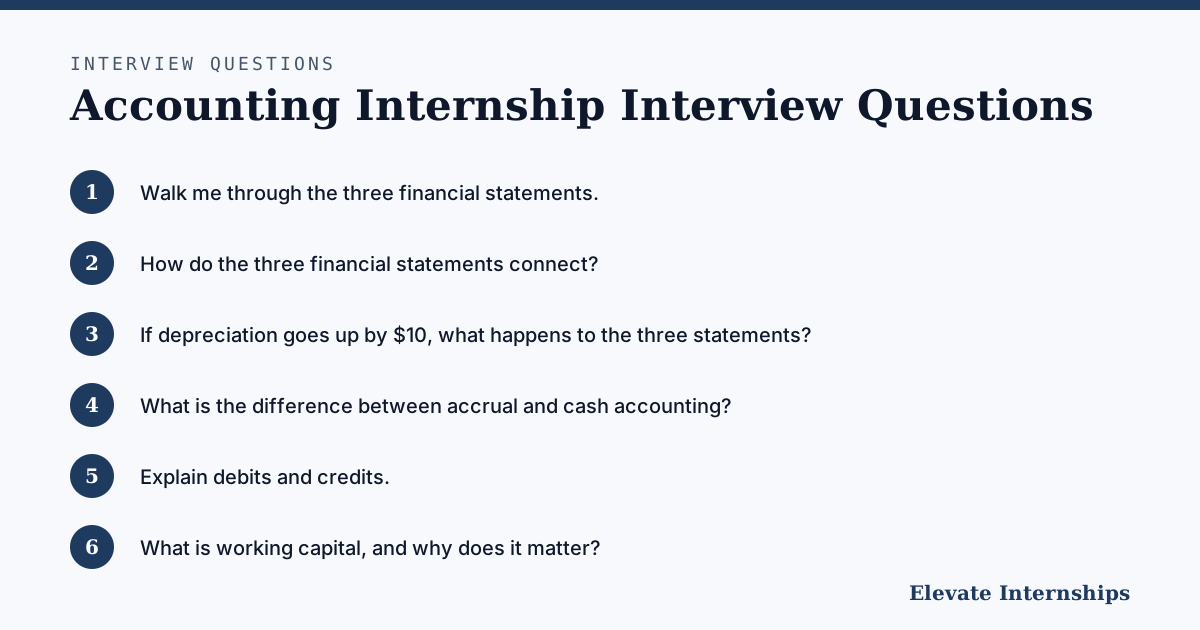
1. Walk me through the three financial statements.
What they are looking for: Whether you understand what each statement shows and can explain it clearly.
How to answer: Describe each in a sentence: the income statement (revenue, expenses and profit over a period), the balance sheet (assets, liabilities and equity at a point in time) and the cash flow statement (cash in and out from operating, investing and financing).
The income statement shows a company's revenue and expenses over a period, like a quarter or a year, and ends with net income. The balance sheet is a snapshot at one moment: what the company owns in assets, what it owes in liabilities, and the owners' equity, and assets always equal liabilities plus equity. The cash flow statement starts with net income, adjusts for non-cash items like depreciation and for changes in working capital, then adds investing and financing activities to show how cash actually changed during the period.
2. How do the three financial statements connect?
What they are looking for: Whether you see the statements as one system rather than three separate reports.
How to answer: Follow net income: it flows to the top of the cash flow statement and into retained earnings on the balance sheet. The ending cash on the cash flow statement is the cash on the balance sheet.
Net income from the income statement is the starting line of the cash flow statement, and it's also added to retained earnings in the equity section of the balance sheet. The cash flow statement then adjusts for non-cash items and changes in balance sheet accounts like receivables and inventory. The net change in cash it calculates, added to the beginning cash balance, gives the ending cash that appears on the balance sheet — which is how the balance sheet stays in balance.
3. If depreciation goes up by $10, what happens to the three statements?
What they are looking for: Whether you can trace one change through all three statements, which is the most common technical follow-up.
How to answer: State a tax rate, then go statement by statement. Assuming a 25% tax rate: net income falls by $7.50, cash rises by $2.50, and the balance sheet still balances.
I'll assume a 25 percent tax rate. On the income statement, pre-tax income falls by $10 and taxes fall by $2.50, so net income drops by $7.50. On the cash flow statement, net income is down $7.50 but I add back the $10 of depreciation because it's non-cash, so cash from operations goes up by $2.50. On the balance sheet, cash is up $2.50 and PP&E is down $10, so assets fall by $7.50; on the other side, retained earnings fall by $7.50, so it balances.
4. What is the difference between accrual and cash accounting?
What they are looking for: Understanding of the matching principle, which audit and tax work depend on.
How to answer: Cash accounting records revenue and expenses when money changes hands; accrual accounting records them when they are earned or incurred. Give a quick example.
Under cash accounting you record revenue when you receive payment and expenses when you pay them. Under accrual accounting, which GAAP requires for most companies, you record revenue when it's earned and expenses when they're incurred, so they match the period they belong to. For example, if a company delivers a service in December but is paid in January, accrual accounting records December revenue and an accounts receivable, while cash accounting would record nothing until January.
5. Explain debits and credits.
What they are looking for: The basic language of bookkeeping, which you will use from the first day.
How to answer: Every transaction has equal debits and credits. Debits increase assets and expenses; credits increase liabilities, equity and revenue. Give one journal entry.
Every journal entry has debits equal to credits, which keeps the accounting equation in balance. Debits increase asset and expense accounts and decrease liabilities, equity and revenue; credits do the opposite. For example, if a company buys $500 of supplies on account, it debits supplies, an asset, for $500 and credits accounts payable, a liability, for $500.
6. What is working capital, and why does it matter?
What they are looking for: Whether you connect balance sheet accounts to a company's short-term health and cash.
How to answer: Working capital is current assets minus current liabilities. Explain that it shows whether a company can cover its short-term obligations and how changes in it affect cash.
Working capital is current assets minus current liabilities, so things like cash, receivables and inventory minus payables and other short-term obligations. It matters because it shows whether a company can pay what's due in the next year. It also affects cash flow: if receivables grow because customers are paying more slowly, that ties up cash even when the income statement looks healthy, which is why the cash flow statement subtracts increases in working capital.
7. What is the difference between audit, tax and advisory work?
What they are looking for: Whether you understand the service lines you are applying to and chose one on purpose.
How to answer: Audit gives an independent opinion on whether financial statements are fairly presented; tax covers compliance and planning; advisory helps clients with problems like risk, systems or deals. Say which you prefer and why.
Audit teams test a company's financial statements and controls so they can give an independent opinion that the statements are fairly presented, which investors and lenders rely on. Tax teams prepare returns and help clients plan around tax rules. Advisory, or consulting, helps clients with specific problems such as risk, technology or transactions. I'm applying to audit because I like seeing how a whole business works, and my [auditing course or experience] showed me I enjoy testing whether the numbers hold up.
8. Why accounting, and are you planning to pursue the CPA?
What they are looking for: Commitment to the career path. Firms invest in interns they expect to return and get licensed.
How to answer: Give a genuine reason you chose accounting and a realistic plan for the credit-hour requirement and the CPA exam in your state.
I chose accounting after my intro class because I liked that there's a right answer you can prove, and that every business depends on it. I'm on track to meet my state's education requirement for the CPA through [150-hour plan, master's program or the experience pathway], and I plan to start the exam [timing]. An internship here would show me which service line I want to build my career in before I commit to it full-time.
Before and after the interview
Research the company, prepare two or three questions of your own, and send a short thank-you email within a day. Then record the interview in your application tracker so you get a reminder and do not lose track of next steps.
Internships for these majors: Accounting internships