Finance Internship Interview Questions
Investment banking, corporate finance and asset management internships add technical questions to the behavioral ones. For an internship, interviewers mainly want to see that you know the core concepts and can reason out loud. Know these cold, and follow the markets for a few weeks before your interviews.
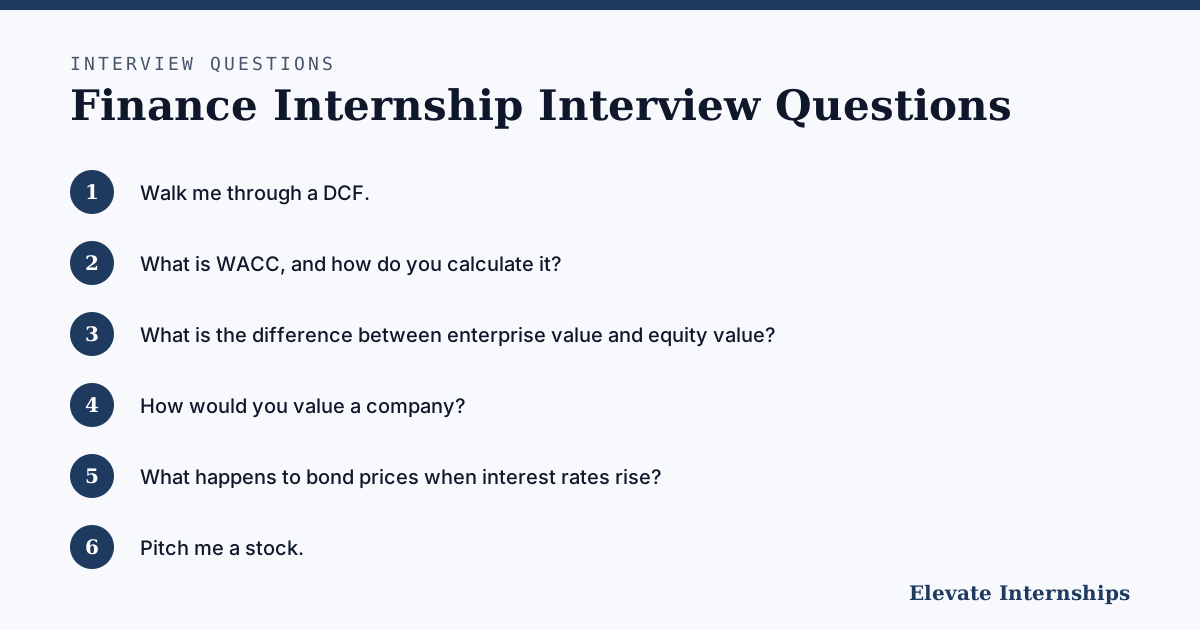
1. Walk me through a DCF.
What they are looking for: Whether you understand how valuation works, not just the steps memorized.
How to answer: Project free cash flow for five to ten years, calculate a terminal value, discount both to today at the weighted average cost of capital, and sum them to get enterprise value. Then bridge to equity value if asked.
A discounted cash flow values a company on the cash it will generate. First I project unlevered free cash flow — operating profit after tax, plus depreciation, minus capital expenditures and increases in working capital — for about five years. Then I estimate a terminal value for the years after that, using either a perpetual growth rate or an exit multiple. I discount the yearly cash flows and the terminal value back to today at the weighted average cost of capital and add them up, which gives enterprise value. To get equity value, I subtract net debt.
2. What is WACC, and how do you calculate it?
What they are looking for: Understanding of the discount rate, which drives any DCF.
How to answer: It is the blended cost of a company's debt and equity, weighted by how much of each it uses. Cost of equity usually comes from CAPM; cost of debt is taken after tax because interest is deductible.
WACC is the weighted average cost of capital — the return a company needs to pay its lenders and shareholders. You weight the cost of equity and the after-tax cost of debt by their shares of the company's total capital. Cost of equity is usually estimated with CAPM: the risk-free rate plus beta times the equity risk premium. Debt is taken after tax because interest expense is tax-deductible, so its cost is the interest rate times one minus the tax rate.
3. What is the difference between enterprise value and equity value?
What they are looking for: A basic concept used in every valuation and deal discussion.
How to answer: Equity value is what the shareholders' stake is worth. Enterprise value is the value of the whole business to all investors: equity value plus debt, preferred stock and noncontrolling interest, minus cash.
Equity value is the value of the company to its shareholders — for a public company, share price times diluted shares outstanding. Enterprise value is the value of the core business to everyone with a claim on it, so you start from equity value, add debt, preferred stock and noncontrolling interests, and subtract cash. That's why two companies with the same equity value can have very different enterprise values if one carries a lot of debt.
4. How would you value a company?
What they are looking for: Whether you know the main methods and when each is useful.
How to answer: Name the three common approaches — comparable companies, precedent transactions and a DCF — and say that analysts use them together to get a range.
There are three main methods. Comparable companies looks at how the market values similar public companies, using multiples like EV to EBITDA. Precedent transactions looks at what buyers paid for similar companies in past acquisitions, which usually includes a control premium. And a DCF values the company on its own projected cash flows. I'd use all three to build a range, since each has weaknesses — comparables depend on the market's mood and a DCF depends heavily on its assumptions.
5. What happens to bond prices when interest rates rise?
What they are looking for: Understanding of the most basic relationship in fixed income, and by extension of discounting.
How to answer: Bond prices fall when rates rise, because existing bonds pay a fixed coupon that is now less attractive, so their price drops until their yield matches the market. Longer bonds fall more.
They fall. A bond pays fixed coupons, so when new bonds start paying higher rates, an existing bond is only worth buying at a lower price that brings its yield up to the market rate. Longer-maturity bonds are more sensitive because more of their cash flows are discounted at the higher rate for longer. The same logic affects stocks: higher rates raise the discount rate in a valuation, which lowers the present value of future cash flows.
6. Pitch me a stock.
What they are looking for: Whether you can form a view, back it with evidence and consider the risks — the core of investment work.
How to answer: Pick a company you actually follow. Give a one-line recommendation, two or three reasons with numbers, what the market is missing, the main risk and what would change your mind.
I'd buy [company]. First, [a specific driver — for example, revenue from a new product line that grew about 30 percent last year] is becoming a bigger share of sales and has higher margins. Second, it trades at [a multiple] compared with about [peer multiple] for its closest peers, even though it's growing faster. I think the market is focused on [a short-term concern] and missing [the longer-term driver]. The main risk is [a specific risk]; if [a measurable sign] happened, I'd change my view.
7. Why finance, and why this part of finance?
What they are looking for: Whether your interest is informed and will survive a demanding summer.
How to answer: Give a specific origin story, show you understand what the job involves day to day, and connect it to the role.
I got interested in finance when I managed our student investment club's small portfolio and saw how much research goes into a single decision. I chose [investment banking, corporate finance or asset management] because I want to [build models for real transactions, help one company make its financial decisions, or analyze companies over the long term]. I've talked with [a professional or alumnus] about what the day-to-day work is like, including the hours, and it's the kind of work I want to do.
8. Tell me about something happening in the markets.
What they are looking for: Whether you follow financial news and can explain why it matters.
How to answer: Pick one recent event you understand well — a rate decision, an earnings report or a deal — and explain what happened, why, and what it means for the firm or its clients.
I've been following [event — for example, the most recent Federal Reserve rate decision]. [What happened, with one number.] The reason was [the cause, in one sentence]. What I find interesting is what it means for [the firm's area — for example, companies planning to refinance debt this year, or deal activity]. I've been reading about it in [source].
Before and after the interview
Research the company, prepare two or three questions of your own, and send a short thank-you email within a day. Then record the interview in your application tracker so you get a reminder and do not lose track of next steps.
Internships for these majors: Finance internships · Economics internships · Real Estate internships