Behavioral Internship Interview Questions
Almost every internship interview, in every field, starts here. These questions test how you communicate, how you work with people and whether you have thought about why you want the role. Prepare four or five true stories and you can adapt them to nearly all of these.
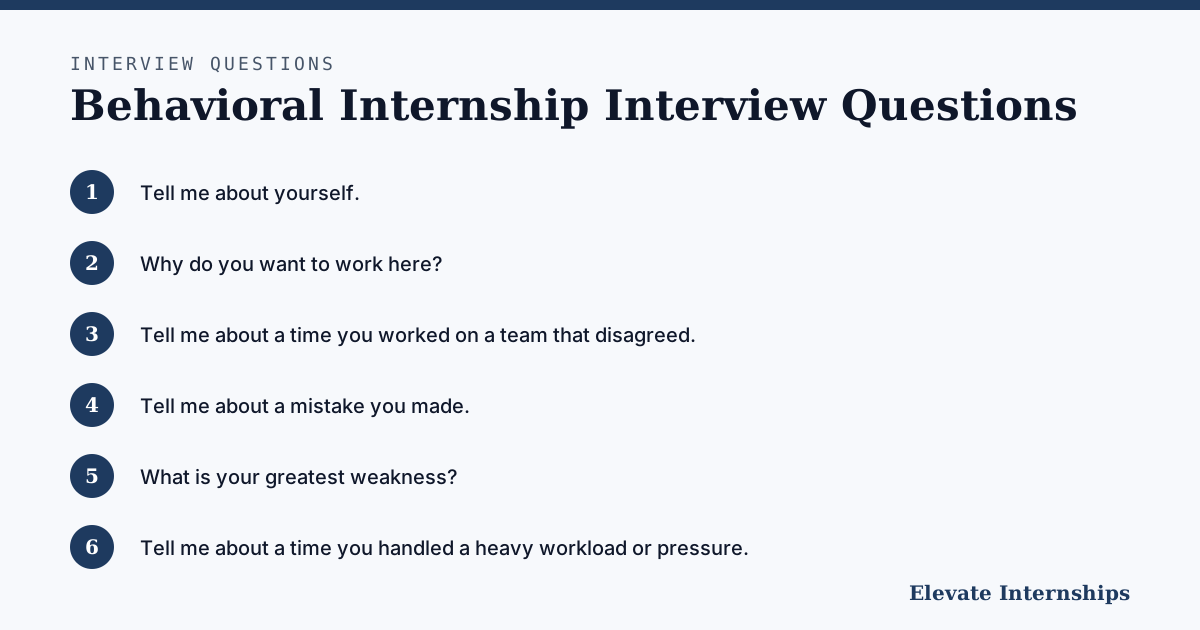
1. Tell me about yourself.
What they are looking for: Whether you can give a short, organized summary that explains why you are in this room for this role.
How to answer: Keep it to about a minute: your year and major, one or two experiences that led you to this field, and why this internship is your next step. Leave out your life story.
I'm a junior at [school] studying [major]. I got interested in business operations when I ran logistics for our campus food drive and we collected 40 percent more than the year before by changing how we scheduled volunteers. Since then I've worked part-time as a shift lead at [employer], where I train new hires, and I've taken [relevant course]. I'm applying for this internship because it would let me work on real process problems with a team, which is the part of my experience I've enjoyed most.
2. Why do you want to work here?
What they are looking for: Whether you researched the company and whether your reasons would still hold if they gave the internship to someone else.
How to answer: Name something specific — a product, a client, a program detail or a person you spoke with — and connect it to what you want to learn. Generic praise ('great culture') does not count.
Two reasons. First, when I talked with [name] at the career fair, she described how interns own a project from start to finish and present it to leadership in August. I want that level of responsibility. Second, your expansion into [market or product] is exactly the kind of growth problem I studied in my [course] project, where our team built a launch plan for a regional brand. I'd like to see how a real company makes those decisions.
3. Tell me about a time you worked on a team that disagreed.
What they are looking for: How you handle conflict: whether you listen, how you move a group to a decision, and whether you can talk about it without blaming anyone.
How to answer: Use STAR — Situation, Task, Action, Result — and spend most of the answer on what you did. End with the result and what you would repeat.
In my marketing class, our group of four split on whether to target first-year students or seniors for a campus coffee shop campaign. Two of us had survey data and two had strong opinions, and we were a week from the deadline. I suggested we each spend 15 minutes making the best case for the other side, then look at the data together. It turned out first-years were visiting more often but spending less, so we built the campaign around them with a loyalty offer to raise spending. We got an A, and I still use that 'argue the other side' step when a group gets stuck.
4. Tell me about a mistake you made.
What they are looking for: Honesty and self-awareness. They want a real mistake, ownership of it, and what you changed afterward.
How to answer: Pick a genuine but recoverable mistake. Say briefly what went wrong, spend more time on how you fixed it, and finish with the habit you built so it does not happen again.
At my part-time job at [employer], I once scheduled two people for the same shift and left Saturday morning uncovered. I noticed on Friday night, called the team, and found someone to cover, so the store opened on time. The real fix was changing how I worked: I started checking the schedule against a simple coverage sheet before posting it. I haven't double-booked anyone since, and my manager asked me to show the other leads the sheet.
5. What is your greatest weakness?
What they are looking for: Self-awareness and whether you are actively working on something, not a disguised strength.
How to answer: Choose a real weakness that will not disqualify you for this role, then describe the specific steps you are taking and the progress so far.
I used to say yes to too many things. Last fall I was in three clubs, working 15 hours a week and taking 17 credits, and the quality of my work slipped on a group project. Since then I block my week in a calendar before agreeing to anything new, and I dropped to two commitments I care about. This semester I've kept a 3.6 while leading our club's events, so it's working, but it's still something I watch.
6. Tell me about a time you handled a heavy workload or pressure.
What they are looking for: Whether you can prioritize, communicate and still deliver when there is more work than time — a normal internship week.
How to answer: Describe the load honestly, then how you decided what came first, who you told, and the result. Show a method, not just long hours.
During midterms last spring I had two exams, a group presentation and extra shifts at work in the same week. On Sunday I listed everything with its deadline and how much it counted, and I asked my manager a week ahead to move one shift, which she did. I did the presentation work first because three other people depended on it, then studied in two-hour blocks. We presented on time and I got a B-plus and an A on the exams. Planning the week on Sunday is something I still do.
7. Where do you see yourself after graduation?
What they are looking for: Whether this internship fits a plan, and whether you are likely to be interested in a return offer.
How to answer: Be honest but connect it to this path: the kind of role you want to grow into, and how this internship builds toward it. It is fine not to have a five-year plan.
I'd like to start in a full-time [type of role] where I'm learning quickly and working with clients or data every day. Longer term I'm interested in managing a team, but first I want to be very good at the work itself. An internship here is the best test of whether this is the right fit, and if it is, I'd be excited about a full-time role after graduation.
8. What questions do you have for us?
What they are looking for: Curiosity and preparation. 'No questions' reads as low interest.
How to answer: Ask two or three questions you cannot answer from the website, about the work, the team or what success looks like. Save salary and time off for later conversations.
I have a few. What does a successful intern accomplish by the end of the summer? What kind of projects did last year's interns work on, and how did they get feedback along the way? And what do you enjoy most about working on this team?
Before and after the interview
Research the company, prepare two or three questions of your own, and send a short thank-you email within a day. Then record the interview in your application tracker so you get a reminder and do not lose track of next steps.
Internships for these majors: Management internships · Human Resources internships · Entrepreneurship internships · International Business internships · Hospitality & Tourism Management internships · Supply Chain & Operations internships · Risk Management & Insurance internships · Business Administration internships · Sport Management internships · Logistics & Transportation internships · Healthcare Management internships · Professional Sales internships · Actuarial Science internships · Financial Planning internships · Retail Management & Merchandising internships · Agribusiness internships