Marketing Internship Interview Questions
Marketing interviews test creativity and judgment in equal measure. Expect to talk about campaigns you noticed, how you would reach an audience, and how you would know it worked. Bring numbers from your own projects wherever you can.
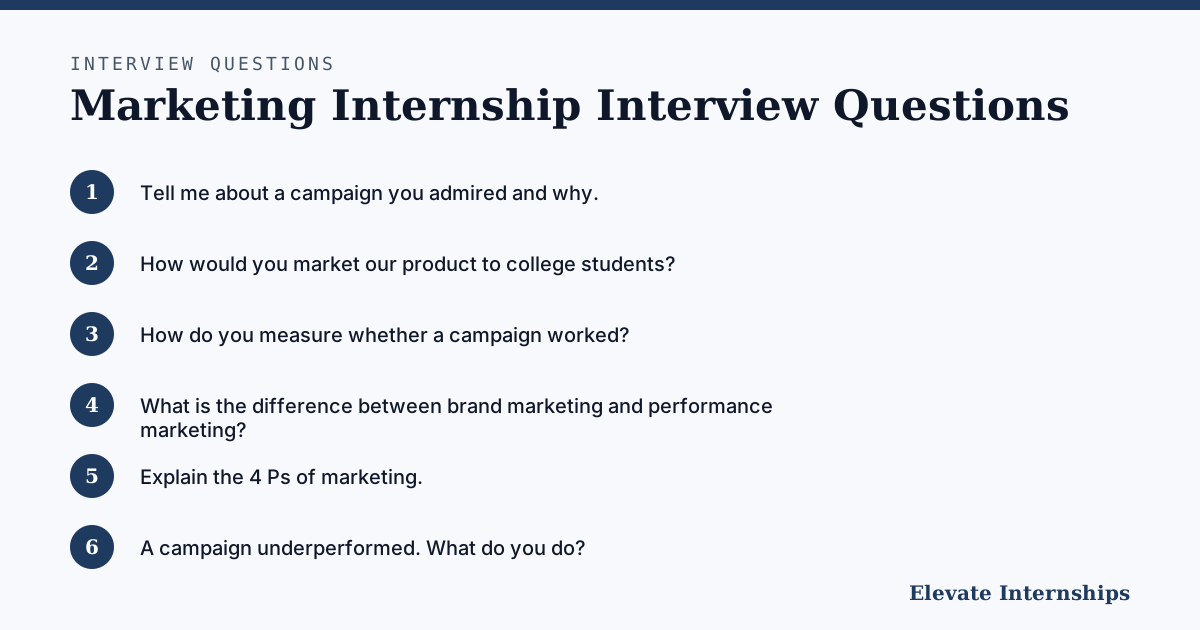
1. Tell me about a campaign you admired and why.
What they are looking for: Whether you notice marketing critically and can explain why something worked, not just that you liked it.
How to answer: Pick a real campaign, describe the audience and the idea in two sentences, then explain why it worked — the insight, the channel and any result you know of.
I liked [brand]'s [campaign], which [what it did in one sentence]. It worked because it was built on a real insight about its audience: [the insight]. It also fit the channel — [why the format suited the platform]. And it gave people a reason to share it, which is why [a visible result, if you know one]. What I took from it is that the strongest campaigns start with a clear point about the customer, not with the format.
2. How would you market our product to college students?
What they are looking for: Your thinking process: audience, message, channels and measurement.
How to answer: Define the audience, pick one clear message, choose two or three channels that fit, and say how you would measure success and test it cheaply first.
I'd start by narrowing the audience, since first-years and seniors want different things; I'd focus on [segment] because [reason]. The message would be [one benefit in a sentence]. For channels I'd use [a social platform where that audience spends time] with short video, plus campus partners like clubs and student ambassadors, because peer recommendations matter a lot on campus. I'd run a small test at two or three schools first and measure sign-ups and cost per sign-up before spending more.
3. How do you measure whether a campaign worked?
What they are looking for: Whether you connect marketing to business results.
How to answer: Start with the goal, then pick metrics that match it: reach and engagement for awareness, click-through and conversion rate for action, and customer acquisition cost and return on ad spend for efficiency.
It depends on the goal, so I'd set that first. For awareness I'd look at reach, impressions and engagement rate. For action, like sign-ups or sales, I'd track click-through rate, conversion rate and cost per acquisition. And to know if it was worth the money, return on ad spend or the cost to acquire a customer compared with what that customer is worth. In a class project, we [example with a number — for example, raised event sign-ups by 25 percent and tracked it with a unique link].
4. What is the difference between brand marketing and performance marketing?
What they are looking for: Understanding of how marketing teams are organized and measured.
How to answer: Brand marketing builds long-term awareness and preference; performance marketing drives measurable actions now, like clicks and purchases. Most companies need both.
Brand marketing builds how people think and feel about a company over time — awareness, trust and preference — and it's measured with things like awareness surveys and search volume. Performance marketing aims for a specific action now, like a click, a sign-up or a purchase, and it's measured directly with conversions and cost per acquisition. They support each other: a strong brand makes performance ads cheaper because people already recognize the name.
5. Explain the 4 Ps of marketing.
What they are looking for: Command of the basic framework from your coursework.
How to answer: Product, price, place and promotion — and a quick example of each for one real product shows you can apply it.
The 4 Ps are product, price, place and promotion — the main decisions in a marketing plan. Take a reusable water bottle brand: the product is the bottle and its design, the price is where it sits against competitors, place is where it's sold, like its own website and outdoor stores, and promotion is how it gets attention, such as influencer partnerships. The framework is useful because a change in one P usually affects the others.
6. A campaign underperformed. What do you do?
What they are looking for: How you respond to bad results: diagnosis before reaction.
How to answer: Check the data first, find where in the funnel people dropped off, form a hypothesis, test one change at a time, and share what you learned.
First I'd check that the tracking is right, because a broken link or tag can look like a failed campaign. Then I'd look at the funnel to find where people dropped off — if many saw it but few clicked, the creative or the targeting is the problem; if many clicked but few converted, it's more likely the landing page or the offer. I'd test one change at a time so I know what fixed it, and I'd write up what we learned for the next campaign.
7. Which social platforms do you use, and what do brands get right on them?
What they are looking for: Whether you understand platforms as a marketer, not only as a user.
How to answer: Name a platform you know well and give a specific brand example, explaining why its content fits that platform's format and audience.
I spend the most time on [platform]. Brands that do well there, like [brand], post content that looks native to the platform — [what they do, for example short, unpolished videos that follow current trends] — instead of repurposing TV ads. They also reply to comments, which makes the account feel like a person. What doesn't work is posting the same thing everywhere; each platform's audience expects something different.
8. Tell me about a time you used data to make a creative decision.
What they are looking for: Whether you can balance creativity with evidence — the everyday job in modern marketing.
How to answer: Use STAR. Show the data you had, the choice it led to, and the result.
I ran social media for [club]. We were posting event flyers that got very little engagement, so I looked at our last 30 posts and saw that photos of members got about three times the likes and comments of flyers. I switched to posting a photo from each event with the next event's details in the caption. Over the semester our average engagement roughly doubled and event attendance went up, and the club still uses that approach.
Before and after the interview
Research the company, prepare two or three questions of your own, and send a short thank-you email within a day. Then record the interview in your application tracker so you get a reminder and do not lose track of next steps.
Internships for these majors: Marketing internships · Sport Management internships · Retail Management & Merchandising internships