Internships for Freshman and Sophomore Business Majors
Most business internships go to juniors, but freshmen and sophomores are not shut out. Many large employers run programs built for first- and second-year students, smaller employers often hire on skills rather than class year, and a year of the right activities makes the junior-year search much easier.
Programs built for freshmen and sophomores
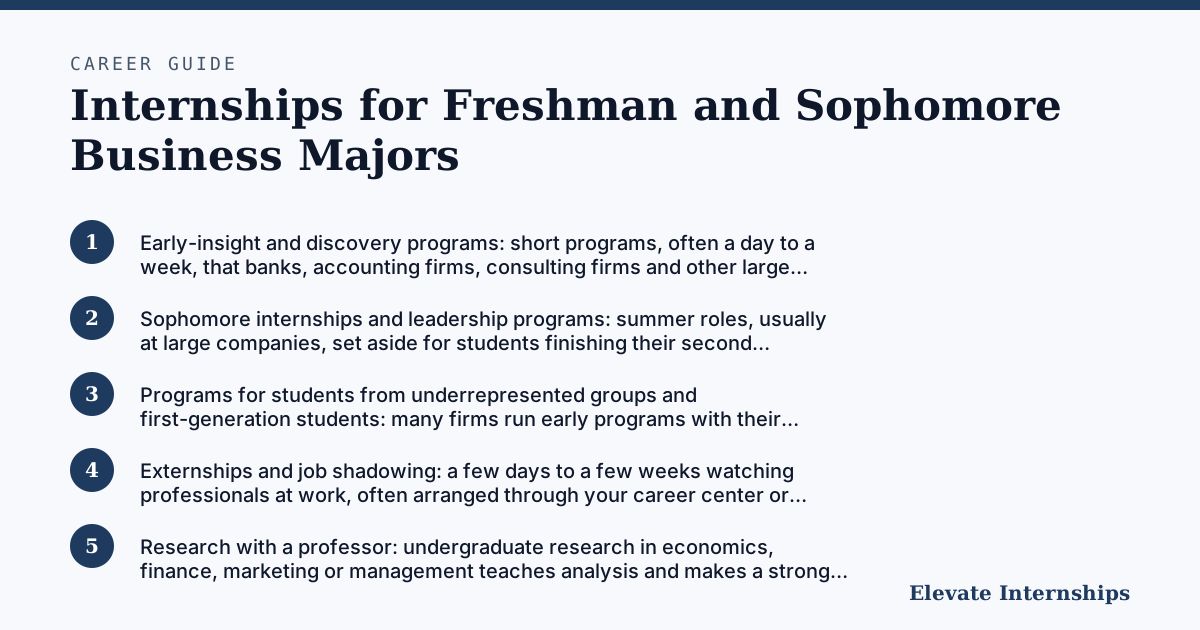
- Early-insight and discovery programs: short programs, often a day to a week, that banks, accounting firms, consulting firms and other large employers run so students can see the work. Some lead to an internship offer the following year.
- Sophomore internships and leadership programs: summer roles, usually at large companies, set aside for students finishing their second year. Look for “sophomore” in a posting’s title or description.
- Programs for students from underrepresented groups and first-generation students: many firms run early programs with their own eligibility rules, so read each one carefully.
- Externships and job shadowing: a few days to a few weeks watching professionals at work, often arranged through your career center or alumni office.
- Research with a professor: undergraduate research in economics, finance, marketing or management teaches analysis and makes a strong resume line. Some positions are paid; ask.
When to apply
Programs for underclassmen often open earlier than students expect. In finance and at some accounting firms, sophomore program deadlines can fall in the autumn of sophomore year, and freshman programs earlier still. Here is when each major’s first opportunities usually come; always check each employer’s own dates.
- Freshman–sophomore year: Big Four and regional firms run sophomore leadership and discovery programs, with applications from late summer into the fall. Go to Meet the Firms and Beta Alpha Psi events.
- Freshman–sophomore year: Early-insight, diversity and sophomore programs at banks and investment firms. Some deadlines fall in the autumn of sophomore year or earlier. Sophomore spring–summer: Applications for junior-summer investment banking and markets roles can open more than a year ahead. Network before they open, not after.
- Sophomore year: Build SQL, Excel and Tableau skills and one portfolio project. Apply to sophomore programs at consulting and technology firms.
- Sophomore year: Build a portfolio: run social media for a campus group and earn the free HubSpot and Google certificates.
- Sophomore year: Lead something on campus — managers are hired for evidence they have led people.
- Sophomore year: Join the ASCM or APICS student chapter, and ask the career center about co-op programs.
- Sophomore year: Join the SHRM student chapter and look for campus recruiting or residence-life roles.
- Sophomore year: Sophomore programs at consulting firms and Big Four technology practices. Earn a cloud or Salesforce credential.
- Sophomore year: Plan study abroad and keep a language going; both are screened for.
- Freshman–sophomore year: Headed for actuarial work? Pass Exam P early — actuarial internships screen for it. Join Gamma Iota Sigma.
- Sophomore year: Hotel and restaurant operations experience counts — even part-time.
- Sophomore year: Learn real estate modeling in Excel; it is the test at most internships. Sophomore spring–junior fall: Real estate private equity and investment banking follow the early finance timeline.
- Sophomore year: Try a club role in finance, marketing or operations, and look for sophomore programs at large companies.
- Freshman–sophomore year: Work game days or events for your athletic department or a local minor-league team. Event experience counts with every sports employer.
- Sophomore year: Join your school’s supply chain or logistics club, often an ASCM student chapter, and ask the career center about co-ops.
- Freshman–sophomore year: Volunteer or work in a hospital, clinic or health plan. Any time around patient care helps in interviews.
- Sophomore year: Join your school’s sales program or club and enter a sales role-play competition; recruiters attend them.
- Freshman–sophomore year: Pass Exam P, then FM, and take VEE-approved courses as part of your degree. Sophomore summer–junior fall: Insurers and actuarial consulting firms recruit interns; many postings ask for at least one passed exam.
- Freshman–sophomore year: Find out whether your program is CFP Board-registered; if it is, your degree covers the CFP coursework.
- Sophomore year: Part-time store or e-commerce work counts; note what you sold, stocked or fixed.
- Freshman–sophomore year: Join your agribusiness club or NAMA student chapter, and spend a summer on a farm, at a co-op or at a grain elevator.
If you do not land a program
Most freshmen and sophomores do not, and that is fine. These count as experience on a resume, and each gives you stories for interviews.
- Get any job and do it well. Retail, food service and campus jobs show reliability, customer service and teamwork, and recruiters count them.
- Take a leadership role in one student organization and do something measurable with it.
- Finish one free job simulation for the field you want, such as the ones on Forage.
- Earn one certification that fits your major. The Finder shows the order to take them in for your major.
- Volunteer your skills: IRS VITA trains students to prepare tax returns, and nonprofits need help with budgets, social media and events.
- Start building relationships: meet your career center, go to employer information sessions, and have two or three conversations with alumni in your field.
How to find them here
Search the Finder by ZIP code. Listings that mention freshmen, sophomores or early-insight programs carry a badge and rank higher, and you can filter the results by type to see externships, research positions and early-career programs alongside internships.
Questions students ask
Can a freshman get a business internship?
Yes, though fewer are open to freshmen than to juniors. Early-insight programs, small businesses, nonprofits and campus offices are the likeliest places, and a summer job or a project counts as experience too.
When should sophomores apply for internships?
For finance and many of the largest firms in other fields, from the autumn of sophomore year, because their programs fill early. For most other employers, in the spring. Check each employer’s deadline.
What should a freshman put on a resume?
Your school and expected graduation date, relevant classes, any job (including retail or food service), activities and leadership roles, projects, and skills such as Excel. Write each item as what you did and what came of it.
Next: find business internships for your major or compare certifications for business majors.