How to get a supply chain & operations internship
Supply chain employers recruit at fall career fairs and through co-op programs, and they look for students who are comfortable with spreadsheets and with how things physically move.
1. Know when supply chain & operations internships recruit
- Sophomore yearJoin the ASCM or APICS student chapter, and ask the career center about co-op programs.
- Junior fall (Sep–Oct)Manufacturers, retailers and logistics companies recruit at fall career fairs.
- About six months aheadCo-ops for fall or spring terms recruit roughly half a year before they start.
- Junior springRemaining summer roles at mid-size firms.
2. Build the skills employers check
- Excel
- Data analysis
- ERP systems such as SAP
- Process improvement (Lean, Six Sigma)
- Negotiation basics
- Communication
3. Take certifications in the right order
None is required, but each shows a skill. Start at the top: the first ones need no background.
- Supply Chain Principles — Georgia Tech · Coursera. Paid · about 20 hours
- Supply Chain, Inventory and Logistics — NRF Foundation · RISE Up. Paid
- Supply Chain Management Specialization — Rutgers · Coursera. Paid · about 60 hours
- SAP Learning journeys — SAP. Free · about 20 hours
- Accenture job simulations — Forage. Free · about 5 hours
The Finder shows the whole path for supply chain & operations, three ways: fastest and free, balanced, and a stretch toward the most demanding credentials. See also every supply chain & operations certification.
4. Aim at the right roles
- Procurement or sourcing intern — Supports buying decisions, supplier comparisons and contracts.
- Logistics or transportation intern — Tracks shipments and looks for faster or cheaper routes.
- Inventory or demand planning intern — Forecasts demand and keeps stock at the right level.
- Operations or manufacturing intern — Improves processes on a production or warehouse floor.
5. Use the words recruiters look for
Put the ones that are true for you on your resume, in your own sentences.
How to write a business internship resume
6. Practice the interview
- Behavioral interview questions, which every business interview asks
- Consulting Internship Interview Questions
Tips for supply chain & operations internships
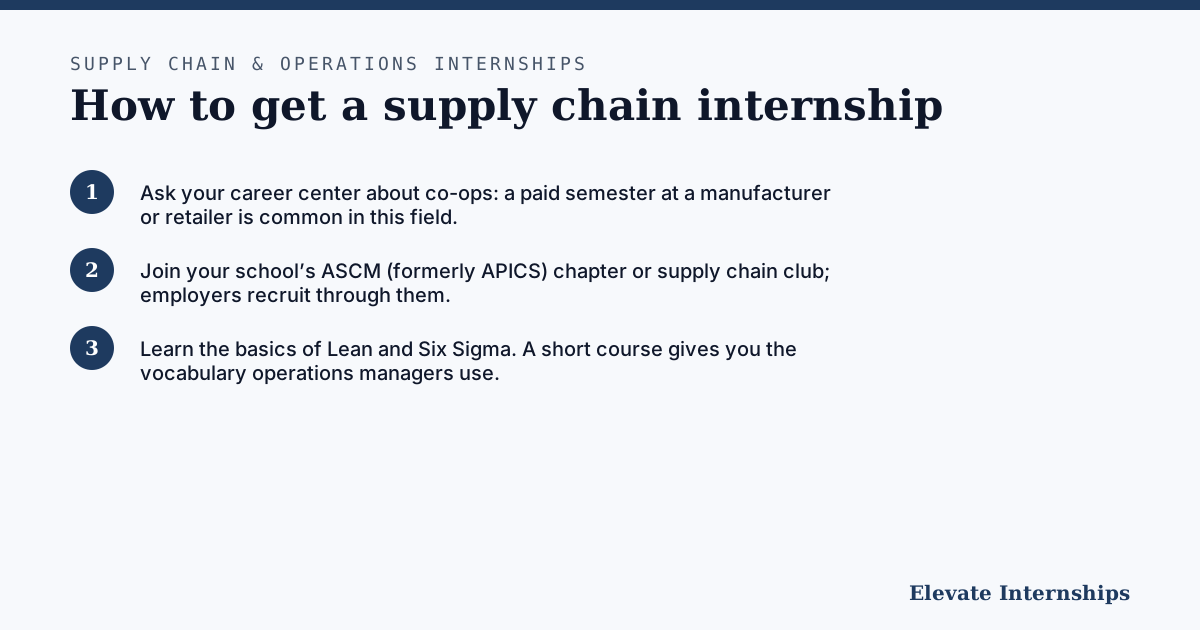
- Ask your career center about co-ops: a paid semester at a manufacturer or retailer is common in this field.
- Join your school’s ASCM (formerly APICS) chapter or supply chain club; employers recruit through them.
- Learn the basics of Lean and Six Sigma. A short course gives you the vocabulary operations managers use.
Find supply chain & operations internships near you →
More on this major: supply chain & operations internships, with recent listings and the questions students ask.