Career guide · Updated October 23, 2026
How to get a finance internship
Finance recruits earlier than any other business field. The students who land the most competitive internships start learning the vocabulary and building relationships in their first two years.
1. Know when finance internships recruit
- Freshman–sophomore yearEarly-insight, diversity and sophomore programs at banks and investment firms. Some deadlines fall in the autumn of sophomore year or earlier.
- Sophomore spring–summerApplications for junior-summer investment banking and markets roles can open more than a year ahead. Network before they open, not after.
- Junior fallRemaining junior-summer roles — corporate finance, asset management, commercial banking and smaller banks — plus interviews.
- Junior summerThe summer analyst internship. Return offers from it fill most full-time analyst classes.
Typical timing — employers set their own dates, so check each one.
2. Build the skills employers check
- Excel financial modeling
- Accounting and the three statements
- Valuation (DCF, comparables)
- PowerPoint
- Market awareness
- Attention to detail under deadlines
3. Take certifications in the right order
None is required, but each shows a skill. Start at the top: the first ones need no background.
- Accounting Fundamentals — Corporate Finance Institute. Paid · about 7 hours
- Finance and capital markets — Khan Academy. Free · about 20 hours
- Introduction to Corporate Finance — Wharton · Coursera. Paid · about 10 hours
- Aswath Damodaran’s valuation classes — NYU Stern. Free · about 30 hours
- Bloomberg Market Concepts — Bloomberg for Education. Check your campus · about 8 hours
The Finder shows the whole path for finance, three ways: fastest and free, balanced, and a stretch toward the most demanding credentials. See also every finance certification.
4. Aim at the right roles
- Investment banking summer analyst — Builds financial models and pitch materials for mergers, acquisitions and capital raises.
- Corporate finance (FP&A) intern — Supports budgeting, forecasting and performance analysis inside a company.
- Sales and trading or markets intern — Supports traders and salespeople, analyzing markets and client flows.
- Wealth or asset management intern — Researches investments and supports portfolio and client teams.
- Commercial banking or credit intern — Analyzes businesses applying for loans and monitors existing credit.
5. Use the words recruiters look for
Put the ones that are true for you on your resume, in your own sentences.
financial modelingDCFvaluationExcelforecastingfinancial analysisPowerPointBloombergdue diligencevariance analysis
How to write a business internship resume
6. Practice the interview
- Behavioral interview questions, which every business interview asks
- Finance Internship Interview Questions
Tips for finance internships
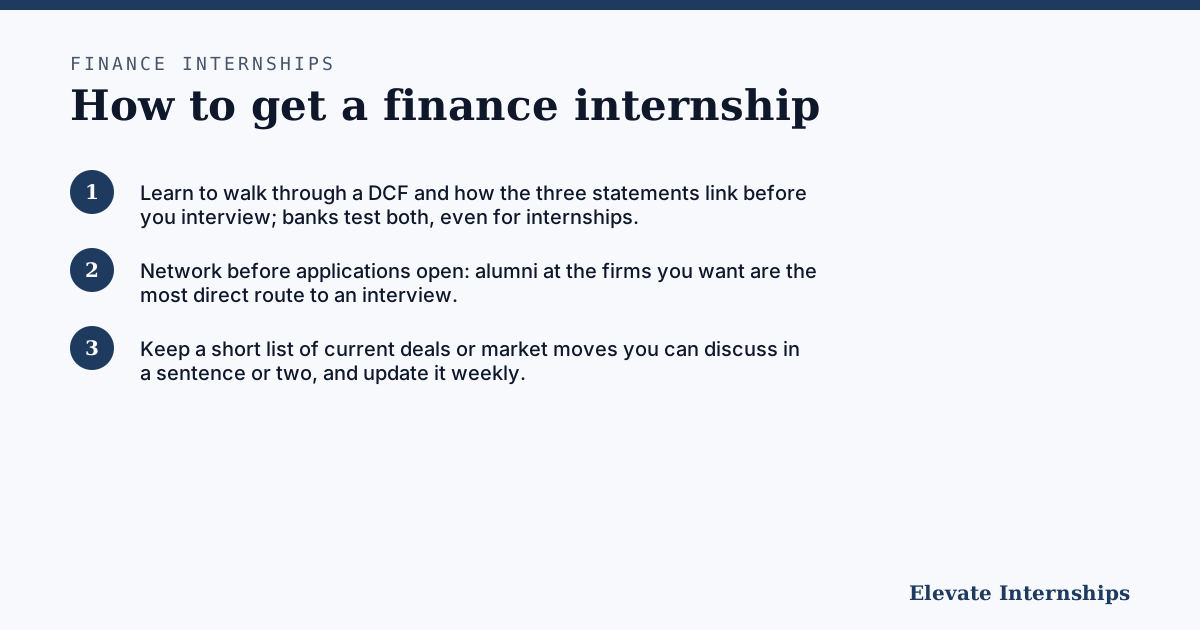
- Learn to walk through a DCF and how the three statements link before you interview; banks test both, even for internships.
- Network before applications open: alumni at the firms you want are the most direct route to an interview.
- Keep a short list of current deals or market moves you can discuss in a sentence or two, and update it weekly.
Find finance internships near you →
More on this major: finance internships, with recent listings and the questions students ask.