Best certifications for finance students
The vocabulary interviewers assume, the modeling they test, and the charters that follow.
Finance internships for college students
When finance recruits
- Freshman–sophomore year — Early-insight, diversity and sophomore programs at banks and investment firms. Some deadlines fall in the autumn of sophomore year or earlier.
- Sophomore spring–summer — Applications for junior-summer investment banking and markets roles can open more than a year ahead. Network before they open, not after.
- Junior fall — Remaining junior-summer roles — corporate finance, asset management, commercial banking and smaller banks — plus interviews.
- Junior summer — The summer analyst internship. Return offers from it fill most full-time analyst classes.
Finance recruiting starts early and moves fast, so a certification that proves you can already model, read markets or understand regulation is worth more here than in most fields. Most of the best options for students are free or low-cost and can be done in a few weeks — the few that cost real money are listed with their actual prices so you can decide if they are worth it.
How to choose
- Get Excel and financial modeling basics first; nearly every finance interview tests them.
- If your school has a Bloomberg Terminal, Bloomberg Market Concepts is usually free through the library and widely recognized.
- The FINRA Securities Industry Essentials (SIE) exam is one of the few licenses a student can take without an employer sponsor, and it shows commitment to markets roles.
- Longer programs such as the CFA are for later: they are valuable but take years and are not expected of interns.
Certifications for Finance majors
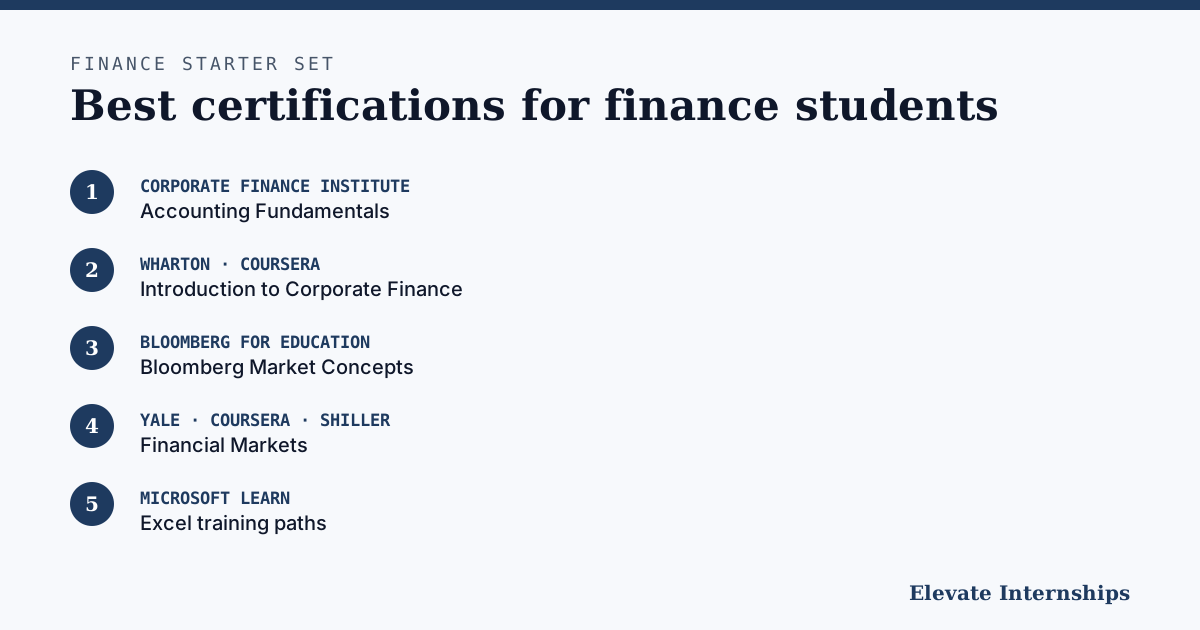
- Accounting Fundamentals — Corporate Finance Institute. Free: Free. Debits, credits, and how the three statements link. Short and genuinely free.
- Introduction to Corporate Finance — Wharton · Coursera. Free to audit: Free to audit; certificate ~$49. Time value of money, NPV, and cost of capital. The vocabulary every finance interview assumes.
- Bloomberg Market Concepts — Bloomberg for Education. Check your campus: Free through a school with Bloomberg terminals; otherwise ~$149. Economic indicators, currencies, fixed income, and equities on live terminal data. Check your library before paying.
- Financial Markets — Yale · Coursera · Shiller. Free to audit: Free to audit; certificate ~$49–$79. Robert Shiller on risk, behavioural finance, and institutions. The best free markets course there is.
- Excel training paths — Microsoft Learn. Free: Free. Formulas, pivot tables, and Power Query. The single most assumed skill in any business internship.
- FMVA — Financial Modeling & Valuation Analyst — Corporate Finance Institute. Paid: ~$497–$847/yr for full access, with about 50% off for students using a school email. Individual courses often free to audit. Build a three-statement model and a DCF from scratch. The most practical paid option for banking interviews.
- CFA Level I — CFA Institute. Paid: Exam ~$1,140 with early registration or ~$1,490 standard; the one-time enrollment fee was dropped in 2026. Scholarships exist for students. The investment-management standard. Level I is sittable in your final year; ask about the Access Scholarship.
- J.P. Morgan job simulations — Forage. Free: Free. Investment Banking and Quantitative Research are the usual pair for a finance or analytics track.
- Goldman Sachs job simulations — Forage. Free: Free. Operations, Controllers, and Risk. Controllers pairs neatly with an accounting course.
- SIE — Securities Industry Essentials exam — FINRA. Paid: $80 exam fee. No firm sponsorship needed. The one securities license exam a student can take without an employer. Passing it before recruiting signals commitment to banks and brokerages.
- Aswath Damodaran’s valuation classes — NYU Stern. Free: Free — lectures, spreadsheets and data sets. The most-cited valuation teacher alive puts his entire course online. Use the data sets for any stock pitch.
- Citi job simulations — Forage. Free: Free. A second bank sim alongside J.P. Morgan reads as deliberate rather than accidental.
- Finance and capital markets — Khan Academy. Free: Free. Interest, bonds, stocks and mortgages from zero. A gentle start before Yale or Wharton.
- IMF free online courses — International Monetary Fund. Free: Free. Macroeconomic policy taught by IMF staff. Strong for economics and international business tracks.
- Excel Skills for Business Specialization — Macquarie · Coursera. Free to audit: Free to audit; certificate via Coursera subscription. From first formula to lookups, pivot tables and dashboards. Pairs with the MOS exam.
- Finance for Everyone Specialization — McMaster · Coursera. Free to audit: Free to audit; certificate via Coursera subscription. Decisions, markets, value and debt — finance explained from first principles, with no prerequisites.
- Introduction to Financial Accounting — Wharton · Coursera. Free to audit: Free to audit; certificate ~$49. Brian Bushee builds the three statements from transactions up. Do this before any modeling course.
- Startup Valuation Methods — Michigan · Coursera. Free to audit: Free to audit. How early-stage companies are actually valued. Useful for VC and startup-finance interviews.
- LinkedIn Learning via your library — LinkedIn Learning. Check your campus: ~$40/month retail, but free through most university and public libraries. Rarely worth paying for — check your university and public library cards first, where it is usually free.
- CAIA — Chartered Alternative Investment Analyst — CAIA Association. Paid: Enrollment ~$400 plus ~$1,000 per level (2 levels). Private equity, hedge funds, and real assets. Narrower than the CFA and well regarded in alternatives.
- CFP — Certified Financial Planner — CFP Board. Paid: Exam ~$925; required coursework $3,000–$8,000 unless your degree is CFP-registered. For wealth management and advisory. Check whether your school's finance program is already CFP-registered — that removes the coursework cost.
- CMA — Certified Management Accountant — IMA. Paid: Student member ~$210/yr; exam ~$311 per part (2 parts), entrance fee ~$210. The corporate-side counterpart to the CPA. Cheaper, faster, and aimed at FP&A and internal reporting.
- CPA — Certified Public Accountant — AICPA / NASBA. Paid: ~$1,400 in exam and application fees (varies by state), plus a review course ($1,500–$3,000). Most states require 150 credit hours to be licensed. The license for public accounting. Start planning the 150-hour requirement in your sophomore year, not your senior year.
- CPCU — Chartered Property Casualty Underwriter — The Institutes. Paid: Roughly $3,500–$5,000 in total across 8 courses and exams; employers very often pay. The insurance industry's core designation. Almost always employer-funded once you are hired.
- CTP — Certified Treasury Professional — AFP. Paid: Exam ~$1,050 ($795 members). Usually taken after a couple of years in role. Corporate treasury and cash management. Worth knowing about now, sitting later.
- Exam P — Probability — Society of Actuaries. Paid: Exam ~$275; check SOA for the current fee. The first actuarial exam. Passing it before graduation is close to a requirement for actuarial internships.
- FRM — Financial Risk Manager — GARP. Paid: Enrollment ~$400 plus ~$600–$800 per part (2 parts). Market, credit, and operational risk. The usual credential for bank risk and treasury roles.
- MOS: Excel Associate (MO-210) — Microsoft / Certiport. Paid: Exam ~$100; often free or discounted through a campus testing center. A verifiable Excel credential rather than a line that says 'proficient in Excel'. Ask your career center about a voucher.
- PL-300: Power BI Data Analyst — Microsoft. Paid: Training free; exam ~$165. Student discounts available. The training is free and the exam is not. The most recognised BI credential in corporate roles.
- Sustainable Investing Certificate — CFA Institute. Paid: USD 890, including the exam. CFA Institute’s ESG credential (formerly the Certificate in ESG Investing). Useful for asset-management and sustainability roles.
- Wall Street Prep Financial Modeling — Wall Street Prep. Paid: ~$500–$700 per package; heavy student discounts and campus site licenses. What many banks use for their own analyst training. Check whether your business school already has a license.
- Federal Reserve Education — Federal Reserve. Reference: Free. How the Fed sets rates, straight from the Fed. Also runs the College Fed Challenge.
Questions students ask
What is the best certification for a finance internship?
There is no single best one. For most students, a financial modeling course plus Bloomberg Market Concepts covers what interviews test. The SIE exam is a strong signal for trading, wealth management and brokerage roles.
Can a college student take the SIE exam?
Yes. FINRA lets anyone 18 or older take the SIE without being sponsored by a firm, and a passing result stays valid for four years.
Should I start the CFA program in college?
Only if you are sure about investment management and can commit hundreds of study hours. CFA Institute allows enrollment near the end of a bachelor's degree; check its current eligibility rule before registering.
Other majors
Accounting · Business Analytics · Marketing · Management · Supply Chain & Operations · Human Resources · Management Information Systems · Economics · Entrepreneurship · International Business · Risk Management & Insurance · Hospitality & Tourism Management · Real Estate