Best certifications for economics students
Macro and markets, with the quantitative tooling employers expect alongside.
Economics internships for college students
When economics recruits
- It depends on the path — Headed to finance or consulting? Follow their earlier timelines — see Finance and Management.
- Junior fall — Consulting, economic consulting and bank roles recruit.
- Winter–spring — Government, Federal Reserve and think-tank summer internships usually open.
- Senior fall — Research-assistant roles for after graduation, including at the Federal Reserve, typically open.
Economics majors land internships in research, policy, consulting, banking and data analysis, and what connects those roles is the ability to work with data and explain what it means. Economics has no single professional license, so the most useful certifications here are skill-based: data tools, financial markets and economic data sources. Many of the best ones come from public institutions and cost nothing.
How to choose
- Learn one data tool well — Excel plus R, Python or Stata — since research and consulting roles test it.
- Free courses from the International Monetary Fund, the Federal Reserve and MIT OpenCourseWare show real economics depth.
- If you are leaning toward finance, Bloomberg Market Concepts and financial modeling basics bridge the gap.
- Write up one short analysis using public data (FRED, BLS or Census) to show you can apply what you learned.
Certifications for Economics majors
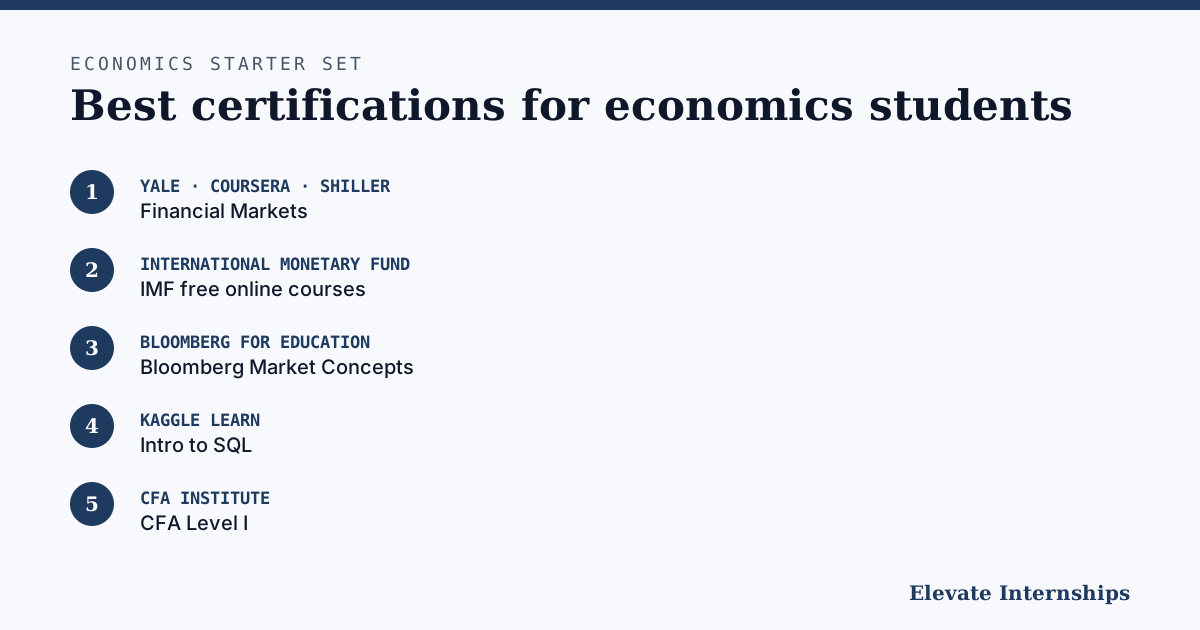
- Financial Markets — Yale · Coursera · Shiller. Free to audit: Free to audit; certificate ~$49–$79. Robert Shiller on risk, behavioural finance, and institutions. The best free markets course there is.
- IMF free online courses — International Monetary Fund. Free: Free. Macroeconomic policy taught by IMF staff. Strong for economics and international business tracks.
- Bloomberg Market Concepts — Bloomberg for Education. Check your campus: Free through a school with Bloomberg terminals; otherwise ~$149. Economic indicators, currencies, fixed income, and equities on live terminal data. Check your library before paying.
- Intro to SQL — Kaggle Learn. Free: Free. SELECT through GROUP BY on real tables. Nobody in analytics escapes SQL.
- CFA Level I — CFA Institute. Paid: Exam ~$1,140 with early registration or ~$1,490 standard; the one-time enrollment fee was dropped in 2026. Scholarships exist for students. The investment-management standard. Level I is sittable in your final year; ask about the Access Scholarship.
- Macroeconomics — Khan Academy. Free: Free. GDP, inflation, monetary and fiscal policy. The vocabulary every markets interview assumes.
- R Programming — Johns Hopkins · Coursera. Free to audit: Free to audit; certificate ~$49. The language most economics departments and research roles expect.
- Data Analysis with Python — freeCodeCamp. Free: Free, including the certificate. Five projects that end in a free, verifiable certificate — and a portfolio to show for it.
- Finance and capital markets — Khan Academy. Free: Free. Interest, bonds, stocks and mortgages from zero. A gentle start before Yale or Wharton.
- Marginal Revolution University — MRU. Free: Free. Short, sharp economics videos from Tyler Cowen and Alex Tabarrok.
- Microeconomics — Khan Academy. Free: Free. Supply, demand, elasticity and market structure — the logic behind every pricing question.
- SAS Skill Builder for Students — SAS. Free: Free training and software; certification exams discounted for students. SAS still runs a great deal of banking, insurance and pharma analytics. Free for students.
- SIE — Securities Industry Essentials exam — FINRA. Paid: $80 exam fee. No firm sponsorship needed. The one securities license exam a student can take without an employer. Passing it before recruiting signals commitment to banks and brokerages.
- Federal Reserve Education — Federal Reserve. Reference: Free. How the Fed sets rates, straight from the Fed. Also runs the College Fed Challenge.
Questions students ask
What certifications help economics students get internships?
Data skills matter most: Excel plus a statistical tool such as R, Python or Stata. Free courses from the IMF or the Federal Reserve add economics credibility at no cost.
Do economics internships require coding?
Research and data-focused roles often do; policy and consulting roles may not. Learning one language well is usually enough for an internship.
Is a finance certification useful for an economics major?
Yes, if you are applying to banking or markets roles. Bloomberg Market Concepts and a financial modeling course are the most common choices.
Other majors
Accounting · Finance · Business Analytics · Marketing · Management · Supply Chain & Operations · Human Resources · Management Information Systems · Entrepreneurship · International Business · Risk Management & Insurance · Hospitality & Tourism Management · Real Estate