Best certifications for logistics & transportation students
Freight, warehouses and the routes between them — and the sales desks that fill the trucks.
Logistics & Transportation internships for college students
When logistics & transportation recruits
- Sophomore year — Join your school’s supply chain or logistics club, often an ASCM student chapter, and ask the career center about co-ops.
- Junior fall (Sep–Oct) — Carriers, freight forwarders, 3PLs and retailers’ distribution teams recruit at fall career fairs.
- Year-round — Freight brokerages and 3PLs often hire sales and operations interns on a rolling basis.
- Junior spring — Remaining summer roles, including warehouse and transportation operations at mid-size firms.
Logistics and transportation employers look for students who understand how freight moves and what it costs, and who are comfortable with numbers and negotiation. Professional credentials from ASCM and CSCMP are aimed at people already in the field, so for students the best investments are Excel, an ERP system and real experience.
How to choose
- Build Excel skills first; rate comparisons, lane analysis and shipment tracking all live in spreadsheets.
- SAP’s free learning journeys show how orders, inventory and shipping connect in an ERP.
- If you are interested in international freight or customs, the Customs Broker License Exam is open to U.S. citizens 18 or older who are not U.S. government employees, and can be taken while you are in school.
- Save CLTD and other professional certifications for after your first role; employers do not expect interns to have them.
Certifications for Logistics & Transportation majors
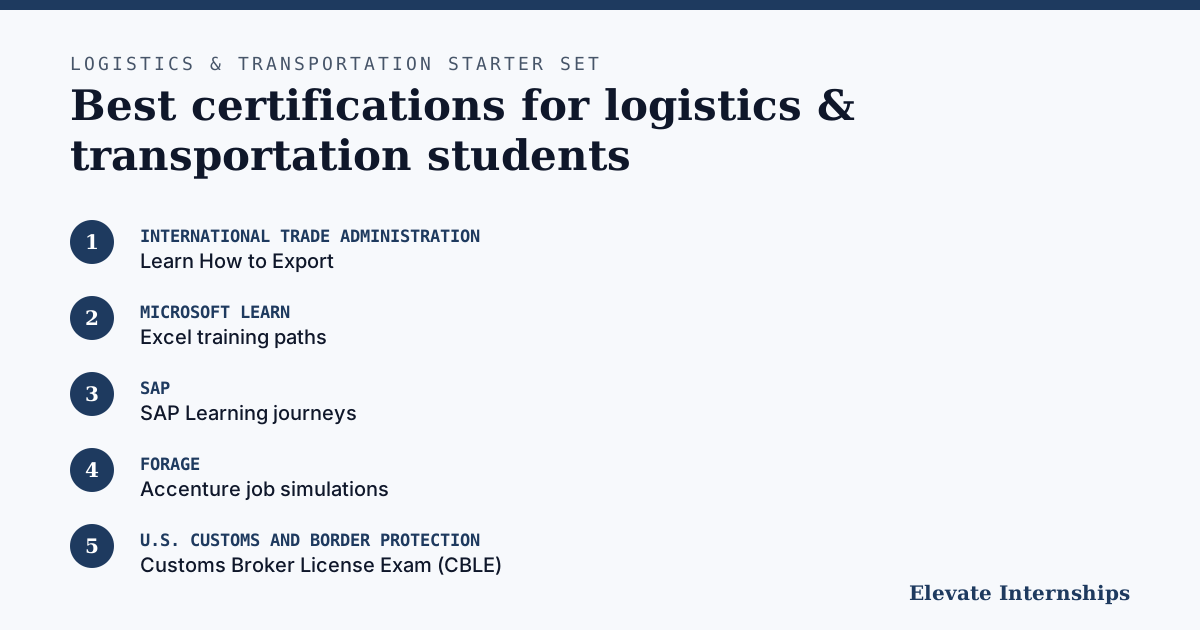
- Learn How to Export — International Trade Administration. Reference: Free. The U.S. government’s own guide to exporting: markets, pricing, shipping and documentation.
- Excel training paths — Microsoft Learn. Free: Free. Formulas, pivot tables, and Power Query. The single most assumed skill in any business internship.
- SAP Learning journeys — SAP. Free: Free learning journeys; certification exams are paid. SAP runs the finance and supply chain of most large companies. The learning journeys are free.
- Accenture job simulations — Forage. Free: Free. Consulting, technology, and strategy tasks. Broad enough for most business majors.
- Customs Broker License Exam (CBLE) — U.S. Customs and Border Protection. Paid: $390 exam fee. Given in April and October; open to U.S. citizens 18 or older. The federal exam behind a U.S. customs broker license: 80 multiple-choice questions on entry, classification and trade rules. It has no degree or work requirement, so you can take it while still in school.
- CLTD — Certified in Logistics, Transportation and Distribution — ASCM. Paid: Exam $1,075 for ASCM members with the certification upgrade or $1,500 otherwise; the bundle with the learning system is $1,980 or $2,760. ASCM’s logistics, transportation and distribution credential: one 150-question exam, about 100 hours of study.
- SCPro Fundamentals — CSCMP. Paid: $300 per course ($360 for non-members), or $1,800 for all eight ($2,160 for non-members). Eight online courses on the cornerstones of supply chain management; each can be earned as its own certificate.
- Certified Customs Specialist (CCS) — NCBFAA Educational Institute. Paid: Price shown at registration; NCBFAA members pay less. A six-month, self-paced online course in U.S. import rules, with 25 modules and a proctored final exam, for work at customs brokers and freight forwarders.
- CGBP — Certified Global Business Professional — NASBITE International. Paid: Exam in the low hundreds of dollars; check NASBITE for the current fee. The recognized credential for international trade: management, marketing, supply chain and trade finance.
- Supply Chain Warehousing Certificate — ASCM. Paid: $495 for ASCM members or $695 otherwise, including the exam. Warehousing and distribution: inventory control, order fulfillment and shipping, built with Prologis. About 20 hours online and one exam; it never expires.
- Supply Chain, Inventory and Logistics — NRF Foundation · RISE Up. Paid: Exams from $60; course and exam bundles from $120. An entry credential in how goods move from suppliers to stores and customers: inventory, warehousing and distribution, with a retail focus.
Key terms for Logistics & Transportation majors
- Logistics
- Third-party logistics (3PL)
- Incoterms
- Lead time
- Just-in-time (JIT)
- Inventory turnover
- Procurement
- Supply chain
Questions students ask
What certification should a logistics student get first?
Start with Excel and a free introduction to ERP systems. Professional credentials such as ASCM’s CLTD are better after you have worked in the field.
Is the customs broker exam worth taking as a student?
It can be if you want to work in importing, freight forwarding or customs brokerage. It costs $390, has 80 multiple-choice questions with 75% needed to pass, is given in April and October, and passing it is a clear signal to those employers.
Are logistics internships paid?
Most are. Carriers, 3PLs and freight brokers usually pay hourly, and co-ops are typically paid full-time roles for a semester.
Checked Oct 29, 2026: CBP: Customs Broker License Exam information, CBP: customs broker fees.
Other majors
Accounting · Finance · Business Analytics · Marketing · Management · Supply Chain & Operations · Human Resources · Management Information Systems · Economics · Entrepreneurship · International Business · Risk Management & Insurance · Hospitality & Tourism Management · Real Estate · Business Administration · Sport Management · Healthcare Management · Professional Sales · Actuarial Science · Financial Planning · Retail Management & Merchandising · Agribusiness