Best certifications for entrepreneurship students
You will be doing the finance and the marketing yourself, so learn both.
Entrepreneurship internships for college students
When entrepreneurship recruits
- Any time — Startups hire on a rolling basis, often four to eight weeks before the start date.
- Junior fall–winter — Venture capital and startup fellowships and accelerator programs set their deadlines.
- Spring — Most startup summer internships are posted.
- Summer — Or build your own project — it counts as experience if you can show what you did.
Entrepreneurship internships — at startups, accelerators, venture funds or small businesses — reward students who can do a bit of everything: talk to customers, run marketing, read a budget and ship something. Certifications matter less here than proof you have built or launched something, so the list focuses on free programs that teach the practical skills founders use and give you a project to point to.
How to choose
- Y Combinator's free Startup School and the U.S. Small Business Administration's free courses cover the basics of starting and running a company.
- Add one growth skill — digital marketing, sales or financial modeling — that a small team will actually need.
- Start something small: a campus service, an online store or a club project with real customers.
- Keep simple metrics (users, revenue, sign-ups) so you can describe results in interviews.
Certifications for Entrepreneurship majors
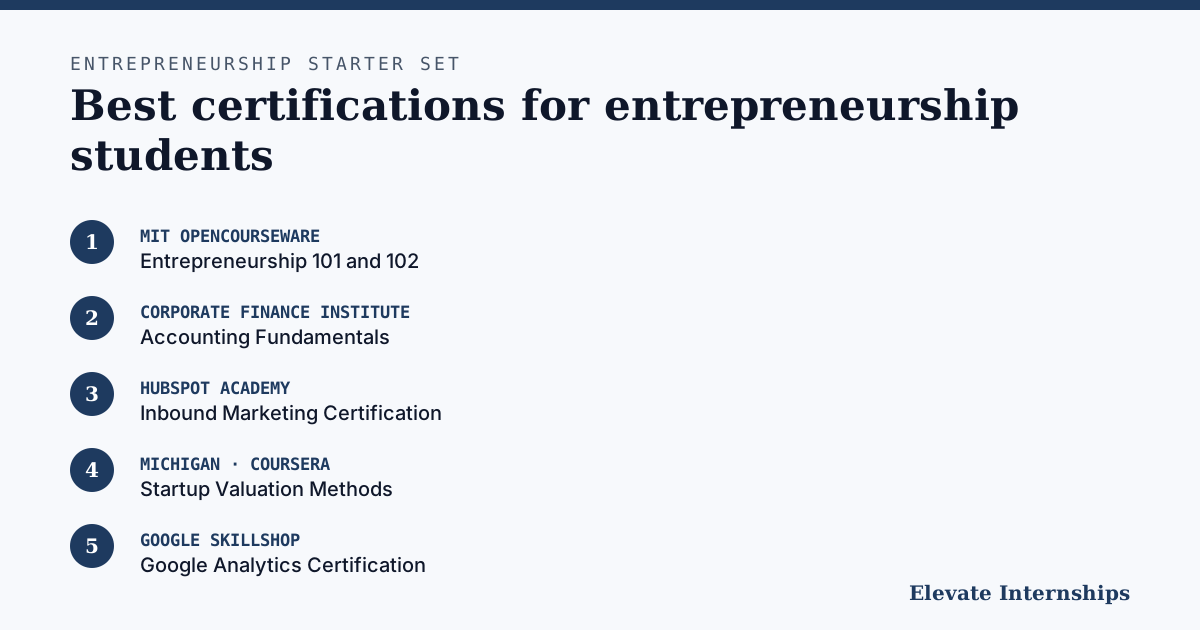
- Entrepreneurship 101 and 102 — MIT OpenCourseWare. Free: Free; no certificate. MIT's new-enterprises material in full. No certificate, but the content is the real thing.
- Accounting Fundamentals — Corporate Finance Institute. Paid: Paid on Coursera (included with Coursera Plus); financial aid available. Debits, credits, and how the three statements link, in a short course.
- Inbound Marketing Certification — HubSpot Academy. Free: Free, certificate included. The inbound funnel and content strategy, free certificate and all.
- Startup Valuation Methods — Michigan · Coursera. Paid: Paid on Coursera (included with Coursera Plus); financial aid available. How early-stage companies are actually valued. Useful for VC and startup-finance interviews.
- Google Analytics Certification — Google Skillshop. Free: Free. GA4 setup, reporting, and attribution. The exam is free and renews annually.
- Startup School — Y Combinator. Free: Free. Y Combinator’s free course on building a startup, plus a co-founder matching service.
- Free small-business counseling (SBA, SCORE, SBDCs) — U.S. Small Business Administration. Free: Free. Free one-on-one mentoring and workshops from SCORE, Small Business Development Centers and the SBA. Use it before you write a business plan alone.
- QuickBooks Online Certification — Intuit ProAdvisor. Free: Free with a free QuickBooks Online Accountant account. The software most small-business clients run their books on. The certification is free and recruiters for small firms look for it.
- Aswath Damodaran’s valuation classes — NYU Stern. Free: Free — lectures, spreadsheets and data sets. The most-cited valuation teacher alive puts his entire course online. Use the data sets for any stock pitch.
- Microeconomics — Khan Academy. Free: Free. Supply, demand, elasticity and market structure — the logic behind every pricing question.
- Xero Advisor Certification — Xero. Free: Free; you need a free Xero login. Online training and assessments in Xero, cloud accounting software that many small businesses and their accountants use. A useful companion to the QuickBooks certification.
- AI For Everyone — DeepLearning.AI · Coursera. Paid: Paid on Coursera; financial aid available. Andrew Ng’s non-technical introduction to what AI can and cannot do for a business, in about 7 hours.
- Entrepreneurship: Launching an Innovative Business — Maryland · Coursera. Paid: Paid on Coursera (included with Coursera Plus); financial aid available. From idea to launch: design thinking, business models and startup financing.
- Finance for Everyone Specialization — McMaster · Coursera. Paid: Paid on Coursera (included with Coursera Plus); financial aid available. Decisions, markets, value and debt — finance explained from first principles, with no prerequisites.
- Generative AI for Everyone — DeepLearning.AI · Coursera. Paid: Paid on Coursera; financial aid available. Andrew Ng on what generative AI can and cannot do for a business. Every interviewer is asking about it.
- Google AI Essentials — Google · Coursera. Paid: Paid on Coursera (included with Coursera Plus); financial aid available. Using generative AI tools at work and writing effective prompts. Self-paced; Google says it takes under 10 hours.
- Google Cloud Generative AI Leader — Google Cloud. Paid: $99 exam fee; the learning path is free. A non-technical certification on how generative AI can change a business: 50–60 questions in 90 minutes, no prerequisites.
- Google Digital Marketing & E-commerce Professional Certificate — Google · Coursera. Paid: Paid on Coursera (included with Coursera Plus); financial aid available. Search, email, social and e-commerce in one track, with a Google name on the certificate.
- Private Equity Certificate — CFA Institute. Paid: $890 standard price. Self-paced, about 125 hours with 12 months of access. CFA Institute suggests the Private Markets certificate or CFA Level I first, but neither is required.
4-week study plan: Inbound Marketing Certification
Free. Video lessons and quizzes come first, then a timed exam (HubSpot allows up to three hours). If you do not pass, you can retake it after 12 hours.
- Inbound basics and buyer personas
- Content and how it reaches people
- The rest of the course
- The exam
4-week study plan: Google Analytics Certification
Free on Google Skillshop. The course takes about 2 hours 40 minutes; Google's free demo account lets you practice on real data.
- Set up, and how Google Analytics collects data
- Reports
- Key events and explorations
- Review and the exam
Key terms for Entrepreneurship majors
- Value proposition
- Market sizing
- Venture capital
- Customer acquisition cost (CAC)
- Customer lifetime value (CLV)
- Competitive advantage
- B2B and B2C
- SWOT analysis
Questions students ask
Do startups care about certifications?
Not much. Startups look for initiative and results. A certification helps if it gives you a skill they need right away, like digital marketing or basic financial modeling.
What free programs are good for entrepreneurship students?
Y Combinator's Startup School and the SBA's free learning center are both free and practical. HubSpot's free marketing and sales training is also useful for small teams.
How do I get an internship at a startup?
Reach out directly: many startups hire interns without posting on big job boards. Show you have built or run something, and be specific about how you could help.
Other majors
Accounting · Finance · Business Analytics · Marketing · Management · Supply Chain & Operations · Human Resources · Management Information Systems · Economics · International Business · Risk Management & Insurance · Hospitality & Tourism Management · Real Estate · Business Administration · Sport Management · Logistics & Transportation · Healthcare Management · Professional Sales · Actuarial Science · Financial Planning · Retail Management & Merchandising · Agribusiness