Best certifications for risk management & insurance students
A small major with unusually strong placement, and employers who pay for your credentials.
Risk Management & Insurance internships for college students
When risk management & insurance recruits
- Freshman–sophomore year — Headed for actuarial work? Pass Exam P early — actuarial internships screen for it. Join Gamma Iota Sigma.
- Junior fall (Sep–Oct) — Insurers and brokers recruit at fall career fairs and the Gamma Iota Sigma conference.
- Junior spring — Remaining underwriting, claims and risk internships.
- Junior summer — The internship; insurers convert a large share of interns to full-time.
Risk management and insurance is a specialist field that recruits heavily from business schools, and it has its own professional designations. Insurers, brokers and risk departments look for students who understand how risk is priced, transferred and managed. Several respected credentials offer student-friendly entry points, and actuarial exams can be started while you are still in college.
How to choose
- The Institutes offer introductory designations and courses in risk management and insurance that suit students exploring the field.
- If you are leaning actuarial, the Society of Actuaries' first exams (Probability and Financial Mathematics) can be taken in college and are highly valued.
- Brush up on Excel and data skills; underwriting and analytics roles use them daily.
- Many insurers run structured internship programs — apply early in the fall for the following summer.
Certifications for Risk Management & Insurance majors
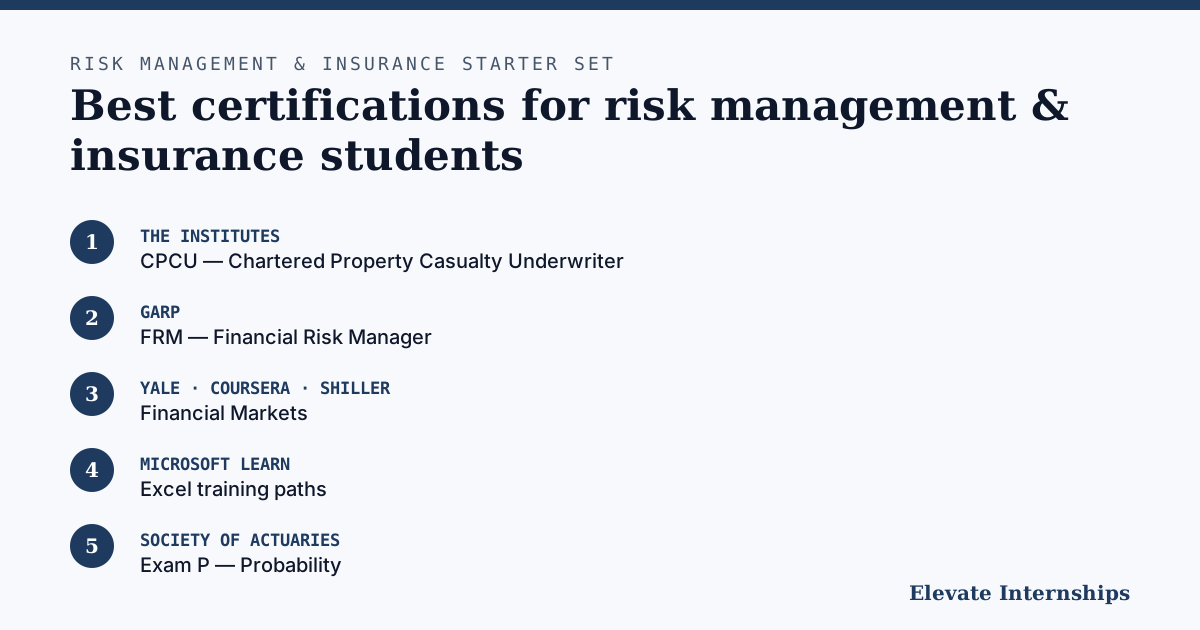
- CPCU — Chartered Property Casualty Underwriter — The Institutes. Paid: Roughly $3,500–$5,000 in total across 8 courses and exams; employers very often pay. The insurance industry's core designation. Almost always employer-funded once you are hired.
- FRM — Financial Risk Manager — GARP. Paid: Enrollment ~$400 plus ~$600–$800 per part (2 parts). Market, credit, and operational risk. The usual credential for bank risk and treasury roles.
- Financial Markets — Yale · Coursera · Shiller. Free to audit: Free to audit; certificate ~$49–$79. Robert Shiller on risk, behavioural finance, and institutions. The best free markets course there is.
- Excel training paths — Microsoft Learn. Free: Free. Formulas, pivot tables, and Power Query. The single most assumed skill in any business internship.
- Exam P — Probability — Society of Actuaries. Paid: Exam ~$275; check SOA for the current fee. The first actuarial exam. Passing it before graduation is close to a requirement for actuarial internships.
- RIMS-CRMP — RIMS. Paid: Several hundred dollars; RIMS has student pricing. The enterprise risk management credential from the risk managers’ professional body.
- CISA — Certified Information Systems Auditor — ISACA. Paid: ~$575 for members, ~$760 for non-members. Student membership is cheap. Where accounting meets IT: auditing systems and controls. In demand at the Big Four for accounting and MIS majors alike.
- SAS Skill Builder for Students — SAS. Free: Free training and software; certification exams discounted for students. SAS still runs a great deal of banking, insurance and pharma analytics. Free for students.
- CFE — Certified Fraud Examiner — ACFE. Paid: Several hundred dollars in exam and membership fees; ACFE has student discounts. Forensic accounting and fraud investigation. The exam can be sat before you have the experience needed to hold the title.
- CIA — Certified Internal Auditor — The IIA. Paid: Student rates available; roughly $1,000–$1,500 all in across three parts. The global standard for internal audit. Big 4 internal-audit and risk practices know it by name.
- CompTIA Security+ — CompTIA. Paid: Exam ~$400; academic pricing is available through many schools. The baseline security certification, required for many government and defense roles.
- Sustainable Investing Certificate — CFA Institute. Paid: USD 890, including the exam. CFA Institute’s ESG credential (formerly the Certificate in ESG Investing). Useful for asset-management and sustainability roles.
Questions students ask
What certifications help with risk management and insurance internships?
Introductory courses and designations from The Institutes are the most directly relevant. For actuarial roles, passing one of the first Society of Actuaries exams is a strong signal.
Can college students take actuarial exams?
Yes. Many students take Exam P (Probability) or Exam FM (Financial Mathematics) during college, and some employers expect at least one passed exam for actuarial internships.
Do I need an insurance license for an internship?
Usually not. Some sales-focused roles encourage or pay for a state license after you join, but most internships do not require one to apply.
Other majors
Accounting · Finance · Business Analytics · Marketing · Management · Supply Chain & Operations · Human Resources · Management Information Systems · Economics · Entrepreneurship · International Business · Hospitality & Tourism Management · Real Estate