Best certifications for agribusiness students
Seed, grain, equipment and food companies, with commodity markets underneath.
Agribusiness internships for college students
When agribusiness recruits
- Freshman–sophomore year — Join your agribusiness club or NAMA student chapter, and spend a summer on a farm, at a co-op or at a grain elevator.
- Junior fall (Sep–Oct) — Seed, crop protection, equipment and food companies recruit at fall career fairs, often for sales and agronomy internships.
- Spring — Co-ops, grain companies and ag lenders fill remaining summer roles.
- Summer — Many ag internships follow the growing season, roughly May to August.
Agribusiness employers look for students who understand farm economics, commodity markets and selling to growers. Few certifications are aimed at agribusiness students, but free courses on futures and hedging, a commodities exam and solid Excel skills are directly useful in merchandising, sales and lending roles.
How to choose
- Start with microeconomics and CME Group’s free courses on futures; grain merchandising runs on futures and hedging.
- The Series 3 is the commodity futures exam. It costs $140 and needs no firm sponsor; take it if you are headed for commodity trading or brokerage.
- Build Excel skills for farm financial analysis and lending roles.
- Sales training helps for seed, crop protection and equipment internships, which often involve visiting growers.
Certifications for Agribusiness majors
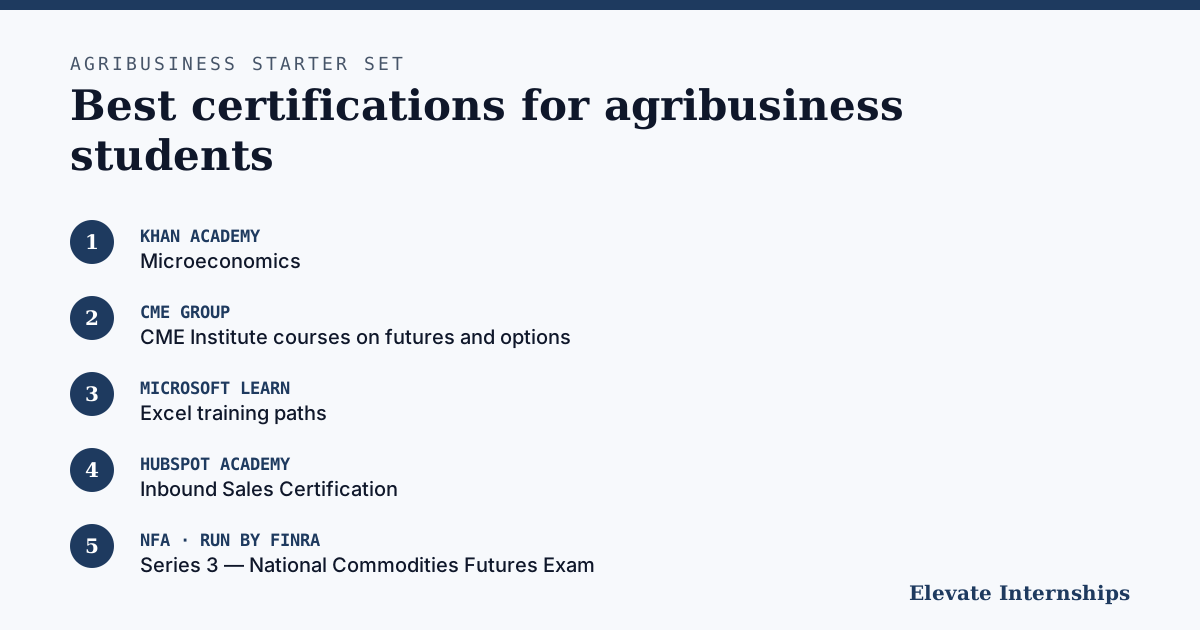
- Microeconomics — Khan Academy. Free: Free. Supply, demand, elasticity and market structure — the logic behind every pricing question.
- CME Institute courses on futures and options — CME Group. Free: Free. Free courses from the exchange group where U.S. grain and livestock futures trade. Start with Introduction to Futures to see how futures are used to manage price risk.
- Excel training paths — Microsoft Learn. Free: Free. Formulas, pivot tables, and Power Query. The single most assumed skill in any business internship.
- Inbound Sales Certification — HubSpot Academy. Free: Free, certificate included. Finding active buyers, personalized outreach, discovery conversations and sales presentations — the work of a first sales job — in about three hours.
- Series 3 — National Commodities Futures Exam — NFA · run by FINRA. Paid: $140 exam fee. No firm sponsorship needed. The futures and commodities exam for people who sell futures, set by the National Futures Association.
- Learn How to Export — International Trade Administration. Reference: Free. The U.S. government’s own guide to exporting: markets, pricing, shipping and documentation.
- Bloomberg Market Concepts — Bloomberg for Education. Check your campus: Free through a school with Bloomberg terminals; otherwise ~$149. Economic indicators, currencies, fixed income, and equities on live terminal data. Check your library before paying.
- Certified Crop Adviser (CCA) — American Society of Agronomy. Paid: Two exams: the International exam (about $280) and a local board exam priced by each board. Certification also needs 2 years of crop-advising experience with an agriculture degree, or 4 without. The credential for agronomists and crop advisers, common in ag sales and agronomy roles at seed, crop protection and grain companies.
4-week study plan: Bloomberg Market Concepts
A self-paced course of about 8 hours. The certificate needs the core modules Bloomberg marks as required; the other modules are optional.
- Access, and economic indicators
- Currencies and fixed income
- Equities, and the rest of the core
- Use it
Key terms for Agribusiness majors
- Futures contract
- Supply and demand
- Price elasticity of demand
- Supply chain
- Procurement
- Derivative
- Exchange rate
- Tariff
Questions students ask
What certifications help agribusiness students?
Free CME Group courses on futures and options, the Series 3 if you want to trade commodities, and Excel. Employers usually teach their own products on the job.
What is grain merchandising?
Buying grain from farmers and selling it to processors, exporters or feeders, while using futures to manage price risk. It is a common internship at grain companies and co-ops.
When do agribusiness internships recruit?
Large companies recruit at fall career fairs; co-ops, grain companies and lenders often hire in the spring for the summer.
Other majors
Accounting · Finance · Business Analytics · Marketing · Management · Supply Chain & Operations · Human Resources · Management Information Systems · Economics · Entrepreneurship · International Business · Risk Management & Insurance · Hospitality & Tourism Management · Real Estate · Business Administration · Sport Management · Logistics & Transportation · Healthcare Management · Professional Sales · Actuarial Science · Financial Planning · Retail Management & Merchandising