Best certifications for financial planning students
Advising households on money: the CFP path, the licensing exams, and real client work.
Financial Planning internships for college students
When financial planning recruits
- Freshman–sophomore year — Find out whether your program is CFP Board-registered; if it is, your degree covers the CFP coursework.
- Junior fall — Wealth management and advisory firms recruit summer interns.
- Twice a year — CFP Board’s virtual career fair lists jobs and internships with planning firms.
- Before you graduate — Pass the SIE — it needs no employer sponsor — and consider the Series 65.
Financial planning has a clear credential path: the CFP at the top, and licensing exams such as the SIE and Series 65 along the way. Students can take the SIE and the Series 65 without an employer sponsor, and a CFP Board-registered degree covers the CFP’s coursework requirement.
How to choose
- Find out whether your program is CFP Board-registered; if it is, you will not pay for separate CFP coursework.
- Pass the SIE before you graduate; it costs $100 and needs no sponsor.
- Consider the Series 65 if you want to work at a registered investment adviser firm.
- Volunteer with IRS VITA to prepare tax returns — it is real client experience.
Certifications for Financial Planning majors
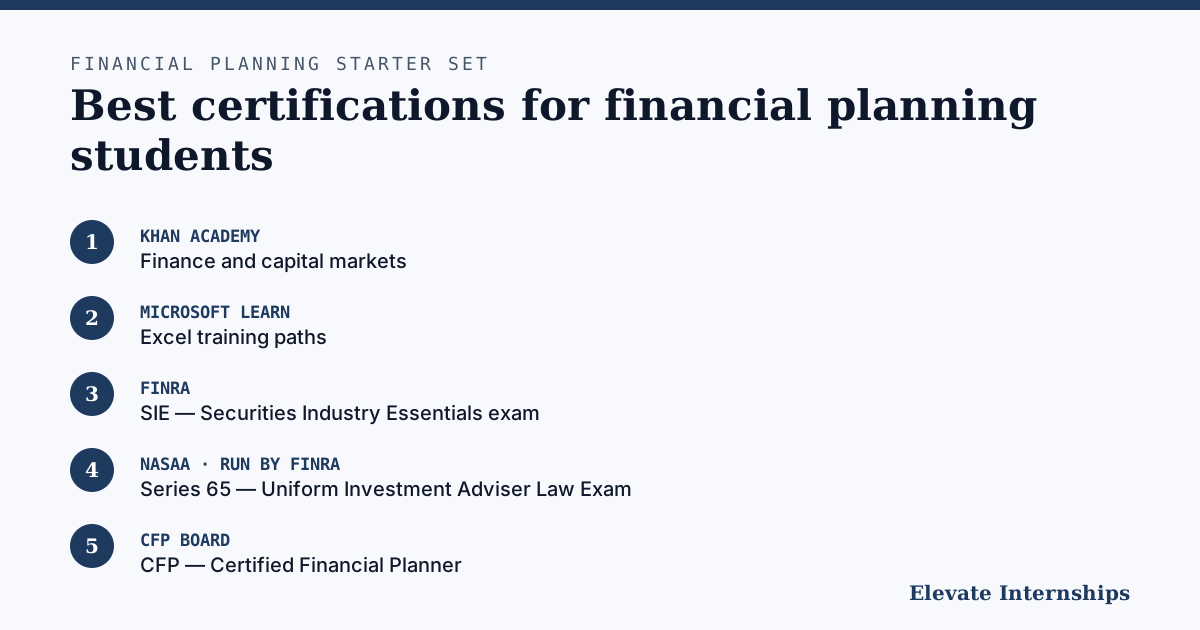
- Finance and capital markets — Khan Academy. Free: Free. Interest, bonds, stocks and mortgages from zero. A gentle start before Yale or Wharton.
- Excel training paths — Microsoft Learn. Free: Free. Formulas, pivot tables, and Power Query. The single most assumed skill in any business internship.
- SIE — Securities Industry Essentials exam — FINRA. Paid: $100 exam fee. No firm sponsorship needed; you must be 18 or older. The one securities license exam a student can take without an employer. Passing it before recruiting signals commitment to banks and brokerages.
- Series 65 — Uniform Investment Adviser Law Exam — NASAA · run by FINRA. Paid: $187 exam fee. No firm sponsorship needed. The investment adviser law exam, written by NASAA and run by FINRA.
- CFP — Certified Financial Planner — CFP Board. Paid: Exam $825–$1,025 depending on when you register; required coursework $3,000–$8,000 unless your degree is CFP-registered. For wealth management and advisory. Check whether your school's finance program is already CFP-registered — that removes the coursework cost.
- VITA tax volunteer certification — IRS. Free: Free. IRS Link & Learn training and the certification test cost nothing. Prepare real returns for real people at a campus or community site. One of the few accounting resume lines with genuine client work behind it.
- FPQP — Financial Paraplanner Qualified Professional — College for Financial Planning (Kaplan). Paid: $1,495–$1,695 for the program, which takes about 120 days. An entry-level designation on the financial planning process. It does not replace the CFP, so check whether your degree already covers the same ground before paying for it.
- ChFC — Chartered Financial Consultant — The American College. Paid: Eight courses from about $985 each; packages start at $6,545. A financial planning designation earned course by course, in as little as eight months. Using it requires three years of financial planning experience.
- CLU — Chartered Life Underwriter — The American College. Paid: Four required courses at $985 each (two for CFP professionals and ChFC holders). The life insurance planning designation, usually finished in 15 months or less. Using it requires financial services experience.
- Investment Foundations Certificate — CFA Institute. Paid: $79 for full-time students ($350 standard). CFA Institute’s introduction to the investment industry: self-paced, 35–65 hours, with a 100-question online assessment and no prerequisites.
- Series 63 — Uniform Securities Agent State Law Exam — NASAA · run by FINRA. Paid: $147 exam fee. No firm sponsorship needed. The state securities law exam for agents. Most states require it along with the Series 7.
- Series 66 — Uniform Combined State Law Exam — NASAA · run by FINRA. Paid: $177 exam fee. No firm sponsorship needed. The combined state law exam for people who are both securities agents and investment adviser representatives. To register you must also pass the SIE and the Series 7 (top-off).
- Series 7 — General Securities Representative Exam — FINRA. Paid: $395 exam fee. A FINRA member firm must sponsor you, so it is taken after you are hired. The exam for brokers, traders and many banking roles. It is paired with the SIE, which you can pass on your own first.
6-week study plan: SIE — Securities Industry Essentials exam
75 multiple-choice questions in 1 hour 45 minutes; a score of 70 passes. Open to anyone 18 or older, and no firm sponsor is needed.
- Capital markets (16% of the exam)
- Products and their risks, part 1 (the largest section: 44% of the exam)
- Products and their risks, part 2
- Trading, customer accounts and prohibited activities (31% of the exam)
- Regulatory framework (9% of the exam) and a first practice exam
- Targeted review and a second practice exam
Key terms for Financial Planning majors
- Fiduciary
- Diversification
- Index fund
- Mutual fund
- Exchange-traded fund (ETF)
- Time value of money
- Asset management
- Broker-dealer
Questions students ask
When can I take the CFP exam?
Once your CFP coursework is complete, which a CFP Board-registered program covers. The degree and work-experience requirements can be finished afterward, within CFP Board’s time limits.
Is the SIE worth it for a financial planning student?
Yes, if you are aiming for wealth management. It needs no sponsor, costs $100 and shows employers you are serious.
Do financial planning internships count toward CFP experience?
They can. CFP Board counts some internship and apprenticeship hours; check its experience rules for what qualifies.
Other majors
Accounting · Finance · Business Analytics · Marketing · Management · Supply Chain & Operations · Human Resources · Management Information Systems · Economics · Entrepreneurship · International Business · Risk Management & Insurance · Hospitality & Tourism Management · Real Estate · Business Administration · Sport Management · Logistics & Transportation · Healthcare Management · Professional Sales · Actuarial Science · Retail Management & Merchandising · Agribusiness