Best certifications for management students
Project delivery and people, which is most of what a manager actually does.
Management internships for college students
When management recruits
- Sophomore year — Lead something on campus — managers are hired for evidence they have led people.
- Junior fall (Aug–Oct) — Rotational and leadership-development programs, and consulting firms, recruit.
- Junior spring — Operations and general business internships at mid-size companies.
- Senior fall — Full-time rotational programs open, often to their own former interns first.
Management internships — operations, consulting, rotational programs — look for students who can organize work and keep projects on track. Project management and process-improvement certifications fit that exactly, and several have entry-level versions designed for people with no work experience. They also give you a shared vocabulary with the teams you will join.
How to choose
- If you want project work, the entry-level CAPM from PMI is designed for people without project experience.
- Agile and Scrum certificates are useful for tech and product-adjacent teams; check whether the exam fee is worth it for your target roles.
- A Lean Six Sigma Yellow Belt introduces process improvement and is common in operations and healthcare management.
- Leadership roles in student organizations count as evidence too — describe them in the same project language.
Certifications for Management majors
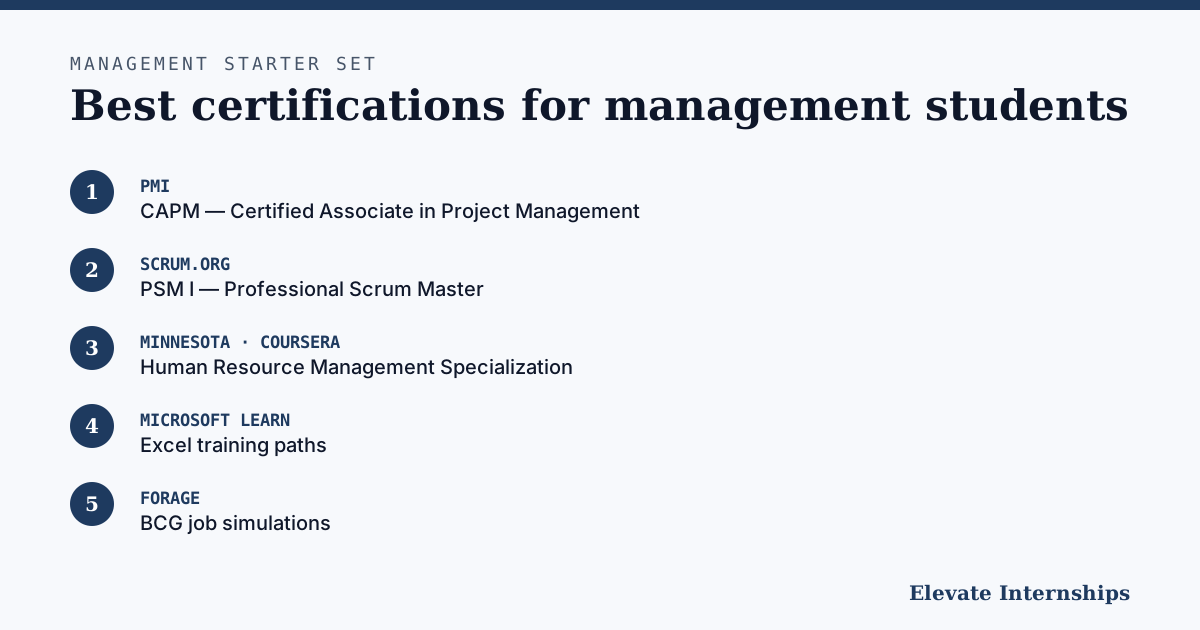
- CAPM — Certified Associate in Project Management — PMI. Paid: Exam ~$225 for PMI members (membership ~$32 for students), ~$300 otherwise. The student-accessible PMI credential — no work experience required, unlike the PMP.
- PSM I — Professional Scrum Master — Scrum.org. Paid: Exam ~$200, no mandatory course. All Scrum.org learning material is free. Cheaper and more rigorous than the weekend CSM course, and it never expires.
- Human Resource Management Specialization — Minnesota · Coursera. Paid: Paid on Coursera (included with Coursera Plus); financial aid available. Hiring, performance, and pay across five courses.
- Excel training paths — Microsoft Learn. Free: Free. Formulas, pivot tables, and Power Query. The single most assumed skill in any business internship.
- BCG job simulations — Forage. Free: Free. Strategy and data-science tasks scored against a real BCG rubric.
- Accenture job simulations — Forage. Free: Free. Consulting, technology, and strategy tasks. Broad enough for most business majors.
- Deloitte job simulations — Forage. Free: Free. Technology, audit, and analytics tracks from one of the Big 4. Usually the shortest sims on the site.
- Entrepreneurship 101 and 102 — MIT OpenCourseWare. Free: Free; no certificate. MIT's new-enterprises material in full. No certificate, but the content is the real thing.
- Human Resource Management (BUS301) — Saylor Academy. Free: Free, including the certificate when you pass the final exam. The certificate is not college credit. Job analysis, recruiting, training, performance reviews, pay, safety and labor relations, with a free certificate of completion.
- Organizational Behavior (BUS209) — Saylor Academy. Free: Free, including the certificate when you pass the final exam. The certificate is not college credit. How people behave at work: individual behavior, group dynamics, conflict and organizational change. The people side of every HR and management role.
- Sales Enablement Certification — HubSpot Academy. Free: Free. CRM hygiene and pipeline mechanics. Useful in any role touching a sales team.
- LinkedIn Learning via your library — LinkedIn Learning. Check your campus: ~$40/month retail, but free through most university and public libraries. Rarely worth paying for — check your university and public library cards first, where it is usually free.
- AI For Everyone — DeepLearning.AI · Coursera. Paid: Paid on Coursera; financial aid available. Andrew Ng’s non-technical introduction to what AI can and cannot do for a business, in about 7 hours.
- AWS Certified AI Practitioner — Amazon Web Services. Paid: $100 exam fee. Foundational AI and generative AI on AWS, open to business roles: 65 questions in 90 minutes.
- AWS Certified Cloud Practitioner — Amazon Web Services. Paid: Exam ~$100. All AWS Skill Builder training for it is free. The business-literate cloud credential. Common for MIS students heading into consulting or tech.
- CSCA — Certified in Strategy and Competitive Analysis — IMA. Paid: About $600 for the exam, or about $1,295 with IMA’s learning series. IMA’s strategy credential. It needs a bachelor’s degree and two years of professional work, or a qualifying accounting or finance certification.
- CSM — Certified ScrumMaster — Scrum Alliance. Paid: $250–$2,495 depending on the trainer; the price covers the 16-hour course and the test. Renew every two years. Scrum Alliance’s Scrum Master credential, earned through a live 16-hour course and a 50-question test. The PSM I is the self-study alternative.
- CSSBB — Certified Six Sigma Black Belt — ASQ. Paid: $585 for the exam; ASQ members pay $100 less. The advanced Six Sigma credential. It needs two completed projects, or one project plus three years of experience, in a full-time paid role; the Green Belt comes first.
- CSSGB — Certified Six Sigma Green Belt — ASQ. Paid: Several hundred dollars; ASQ members pay less. The recognized Six Sigma credential from the quality profession’s own body.
- CTSC — Certified in Transformation for Supply Chain — ASCM. Paid: Sold only as a bundle for first-time test takers: $2,145 for ASCM members with the certification upgrade or $2,990 otherwise. ASCM’s certification on planning and leading supply chain transformation: one 150-question exam, about 100 hours of study.
- ECBA — Entry Certificate in Business Analysis — IIBA. Paid: $395 for IIBA’s package (the exam, its learning journey and a year of membership), or $445 with a practice exam. IIBA members pay $245 or $295. IIBA’s entry-level business analysis credential, built for students and career changers. No work experience needed.
- Excel Skills for Business Specialization — Macquarie · Coursera. Paid: Paid on Coursera (included with Coursera Plus); financial aid available. From first formula to lookups, pivot tables and dashboards. Pairs with the MOS exam.
- Generative AI for Everyone — DeepLearning.AI · Coursera. Paid: Paid on Coursera; financial aid available. Andrew Ng on what generative AI can and cannot do for a business. Every interviewer is asking about it.
- Google AI Essentials — Google · Coursera. Paid: Paid on Coursera (included with Coursera Plus); financial aid available. Using generative AI tools at work and writing effective prompts. Self-paced; Google says it takes under 10 hours.
- Google Cloud Generative AI Leader — Google Cloud. Paid: $99 exam fee; the learning path is free. A non-technical certification on how generative AI can change a business: 50–60 questions in 90 minutes, no prerequisites.
- Google Project Management Professional Certificate — Google · Coursera. Paid: Paid on Coursera (included with Coursera Plus); financial aid available. Traditional and agile project management. Its hours count toward PMI’s CAPM education requirement.
- Leading People and Teams Specialization — Michigan · Coursera. Paid: Paid on Coursera (included with Coursera Plus); financial aid available. Motivation, team design and leading change. The management half of a business degree.
- Microsoft Certified: AI Business Professional (AB-730) — Microsoft. Paid: Exam priced by country; a free practice assessment is on Microsoft Learn. A beginner certification in using Microsoft 365 Copilot and AI agents for business work, with no coding: a 45-minute exam.
- MOS: Excel Associate (MO-210) — Microsoft / Certiport. Paid: Exam voucher ~$104; often free or discounted through a campus testing center. A verifiable Excel credential rather than a line that says 'proficient in Excel'. Ask your career center about a voucher.
- PMI-ACP — Agile Certified Practitioner — PMI. Paid: Exam fee in the hundreds of dollars; PMI members pay less. PMI’s agile credential. It needs 21 hours of agile training, 12 months of project experience and 8 months of agile project experience.
- PMP — Project Management Professional — PMI. Paid: Exam fee in the hundreds of dollars (PMI members pay less), plus 35 hours of required project management training. The best-known project management credential. It needs three years of project experience with a bachelor’s degree (two for graduates of PMI-accredited programs), so start with the CAPM as a student.
- PRINCE2 Foundation — PeopleCert. Paid: Bought from PeopleCert or an accredited trainer; the price varies by country and by training bundle. The project management method used widely in the UK, Europe and government work. The Foundation level has no prerequisites.
- PSPO I — Professional Scrum Product Owner — Scrum.org. Paid: $200 assessment; no course required. The product-owner counterpart to PSM I. Worth having for product management internships.
- Salesforce Certified Administrator — Salesforce. Paid: Exam ~$200 (retake ~$100). All training on Trailhead is free. One of the most hireable business-tech credentials there is. The training costs nothing; only the exam does.
- SHRM-CP — SHRM. Paid: Exam $350–$499 depending on SHRM membership and registration date; students in an HR degree program pay $150–$299. SHRM’s main HR credential. It needs no HR experience or degree, though the exam assumes working knowledge of HR.
- SHRM-SCP — SHRM Senior Certified Professional — SHRM. Paid: Exam $350–$499 depending on SHRM membership and registration date. The senior HR credential. It needs three years of strategic-level HR work, or three years holding the SHRM-CP; start with the SHRM-CP.
- Six Sigma Fundamentals — Kennesaw State · Coursera. Paid: Paid on Coursera (included with Coursera Plus); financial aid available. ASQ belt exams are separate and paid. Process improvement for operations roles. Check whether your school runs its own belt first — it is usually much cheaper.
- Supply Chain Principles — Georgia Tech · Coursera. Paid: Paid on Coursera; financial aid available. A proper introduction to the field from a top-ranked supply-chain school.
8-week study plan: CAPM — Certified Associate in Project Management
150 questions in 3 hours, 15 of them unscored. Before you sit it you need 23 hours of project management education; no work experience is required.
- Set up: the 23 education hours and the exam outline
- Project management fundamentals and core concepts (36% of the exam)
- Fundamentals, continued
- Predictive, plan-based methodologies (17% of the exam)
- Agile frameworks and methodologies (20% of the exam)
- Business analysis frameworks (27% of the exam)
- A full practice exam
- Targeted review and booking the exam
Key terms for Management majors
- SWOT analysis
- Porter’s Five Forces
- Competitive advantage
- Objectives and key results (OKRs)
- Key performance indicator (KPI)
- Stakeholder
- Project scope
- Benchmarking
Questions students ask
What is the best certification for a management major?
For most students, an introductory project management credential such as PMI's CAPM, or a free Agile course, is the most useful. It shows you can plan and deliver work.
Can students get the CAPM?
Yes. PMI designed the CAPM for people early in their careers; it requires 23 hours of project management education rather than work experience. Check PMI for the current fee and requirements.
Do consulting internships want certifications?
Rarely. Consulting firms focus on case interviews and problem solving. A certification helps only if it builds a skill you can use in the case, such as Excel or data analysis.
Other majors
Accounting · Finance · Business Analytics · Marketing · Supply Chain & Operations · Human Resources · Management Information Systems · Economics · Entrepreneurship · International Business · Risk Management & Insurance · Hospitality & Tourism Management · Real Estate · Business Administration · Sport Management · Logistics & Transportation · Healthcare Management · Professional Sales · Actuarial Science · Financial Planning · Retail Management & Merchandising · Agribusiness