Best certifications for management information systems students
The business-technology bridge — and the most hireable certifications in the school.
Management Information Systems internships for college students
When management information systems recruits
- Sophomore year — Sophomore programs at consulting firms and Big Four technology practices. Earn a cloud or Salesforce credential.
- Junior fall (Aug–Oct) — Technology consulting, Big Four risk and technology advisory, and IT rotational programs recruit.
- Junior spring — Company IT departments and startups hire on a rolling basis.
- Junior summer — The internship; return offers are common in consulting.
Management Information Systems sits between business and technology, so MIS internships — IT consulting, systems analysis, cybersecurity, ERP — value certifications that prove technical basics. The good ones are vendor or industry credentials employers recognize immediately, and several entry-level exams from Microsoft, AWS and CompTIA are within reach of a motivated student.
How to choose
- Pick a direction: cloud (AWS or Microsoft Azure fundamentals), security (CompTIA Security+), or data (SQL and analytics).
- Fundamentals-level exams are designed for beginners and are the best first step; check for student discounts before paying.
- Free training from Microsoft Learn, AWS Skill Builder and freeCodeCamp covers most of what the entry exams test.
- Build something small — a database, a dashboard, a cloud-hosted site — so you can show the skill, not just the badge.
Certifications for Management Information Systems majors
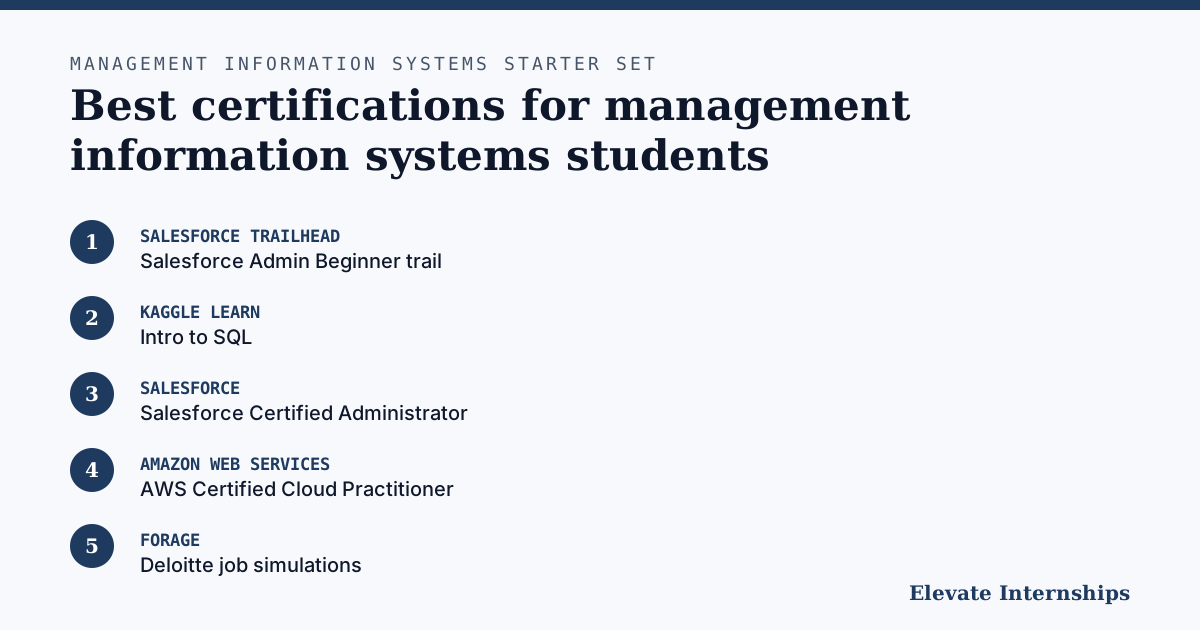
- Salesforce Admin Beginner trail — Salesforce Trailhead. Free: Free. Objects, fields, and reports in a free developer org. Badges link straight to LinkedIn.
- Intro to SQL — Kaggle Learn. Free: Free. SELECT through GROUP BY on real tables. Nobody in analytics escapes SQL.
- Salesforce Certified Administrator — Salesforce. Paid: Exam ~$200 (retake ~$100). All training on Trailhead is free. One of the most hireable business-tech credentials there is. The training costs nothing; only the exam does.
- AWS Certified Cloud Practitioner — Amazon Web Services. Paid: Exam ~$100. All AWS Skill Builder training for it is free. The business-literate cloud credential. Common for MIS students heading into consulting or tech.
- Deloitte job simulations — Forage. Free: Free. Technology, audit, and analytics tracks from one of the Big 4. Usually the shortest sims on the site.
- AZ-900: Azure Fundamentals — Microsoft. Paid: Training free; exam ~$99, with student discounts. Cloud concepts and Azure services. Pairs with AWS Cloud Practitioner for consulting roles.
- Accenture job simulations — Forage. Free: Free. Consulting, technology, and strategy tasks. Broad enough for most business majors.
- Advanced SQL — Kaggle Learn. Free: Free. Joins, window functions and nested data. The SQL that interview case studies actually test.
- Python — Kaggle Learn. Free: Free. Syntax to functions in a browser notebook. The on-ramp to everything else.
- SAP Learning journeys — SAP. Free: Free learning journeys; certification exams are paid. SAP runs the finance and supply chain of most large companies. The learning journeys are free.
- CAPM — Certified Associate in Project Management — PMI. Paid: Exam ~$225 for PMI members (membership ~$32 for students), ~$300 otherwise. The student-accessible PMI credential — no work experience required, unlike the PMP.
- CISA — Certified Information Systems Auditor — ISACA. Paid: ~$575 for members, ~$760 for non-members. Student membership is cheap. Where accounting meets IT: auditing systems and controls. In demand at the Big Four for accounting and MIS majors alike.
- CompTIA Data+ — CompTIA. Paid: Exam ~$250+; academic pricing is available through many schools. A vendor-neutral data analytics credential, recognised by employers that do not use one particular tool.
- CompTIA Security+ — CompTIA. Paid: Exam ~$400; academic pricing is available through many schools. The baseline security certification, required for many government and defense roles.
- DP-900: Azure Data Fundamentals — Microsoft. Paid: Training free; exam ~$99, with student discounts. Relational, non-relational and analytics data on Azure. A cheap named credential for analytics and MIS majors.
- Google Advanced Data Analytics Professional Certificate — Google · Coursera. Paid: Coursera subscription, ~$49/month; financial aid available. The step after Google Data Analytics: Python, statistics and regression models.
- Google Business Intelligence Professional Certificate — Google · Coursera. Paid: Coursera subscription, ~$49/month; financial aid available. Dashboards, data models and pipelines — what a BI analyst builds all week.
- PSM I — Professional Scrum Master — Scrum.org. Paid: Exam ~$200, no mandatory course. All Scrum.org learning material is free. Cheaper and more rigorous than the weekend CSM course, and it never expires.
- PSPO I — Professional Scrum Product Owner — Scrum.org. Paid: $200 assessment; no course required. The product-owner counterpart to PSM I. Worth having for product management internships.
- Salesforce Certified Platform Foundations — Salesforce. Paid: Training free on Trailhead; the exam has a fee — check Trailhead. The entry-level Salesforce credential (formerly Salesforce Associate) — a good first step before the Administrator exam.
Questions students ask
What is the best certification for an MIS student?
An entry-level cloud certification such as AWS Cloud Practitioner or Microsoft Azure Fundamentals is a strong start, because so many MIS roles touch cloud systems. CompTIA Security+ suits students heading toward cybersecurity.
Are MIS certifications expensive?
Exams usually cost money, but the training for most entry-level exams is free. Look for student discounts and free exam vouchers from campus programs and events.
Do MIS internships prefer certifications or projects?
Both help, but projects are more convincing. A certification plus one small project you can explain is a strong combination.
Other majors
Accounting · Finance · Business Analytics · Marketing · Management · Supply Chain & Operations · Human Resources · Economics · Entrepreneurship · International Business · Risk Management & Insurance · Hospitality & Tourism Management · Real Estate