Best certifications for accounting students
Statements first, then the license that defines the profession.
Accounting internships for college students
When accounting recruits
- Freshman–sophomore year — Big Four and regional firms run sophomore leadership and discovery programs, with applications from late summer into the fall. Go to Meet the Firms and Beta Alpha Psi events.
- Junior fall (Aug–Oct) — The main recruiting window, for internships the following winter (busy season) or summer. Most offers go to students the firms met at fall events.
- Junior winter or summer — The internship itself. Strong interns usually receive a full-time offer before senior year begins.
- From day one — Plan the 150 credit hours the CPA requires — it shapes your course load, not just your final year.
Accounting is one of the few business fields with a license at the end of the road: the CPA. As a student you cannot sit for it yet, but you can show recruiters that you already work like an accountant. The certifications below are the ones that do that for the lowest cost — software skills firms use every day, tax and audit training you can use right away, and early steps toward the CPA itself.
How to choose
- Start with a free one you can finish in a weekend, such as QuickBooks ProAdvisor training or an Excel course, and put it on your resume before recruiting starts.
- If you want public accounting, IRS VITA volunteer certification gives you real tax-return experience to talk about in interviews.
- Plan for the CPA early: most states require 150 semester hours to be licensed, and some now offer a 120-hour path with extra work experience. Check your state board's current rule.
- Pay for a credential only when a posting or a mentor in your target firm asks for it.
Certifications for Accounting majors
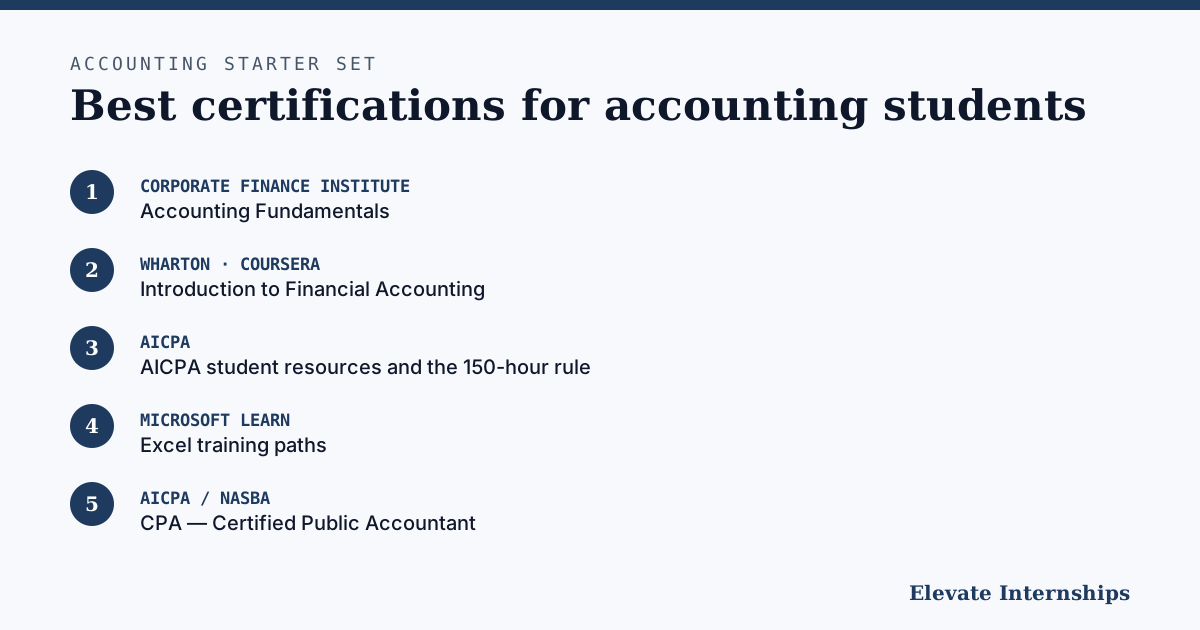
- Accounting Fundamentals — Corporate Finance Institute. Free: Free. Debits, credits, and how the three statements link. Short and genuinely free.
- Introduction to Financial Accounting — Wharton · Coursera. Free to audit: Free to audit; certificate ~$49. Brian Bushee builds the three statements from transactions up. Do this before any modeling course.
- AICPA student resources and the 150-hour rule — AICPA. Reference: Free; student membership is free. Free student membership plus the state-by-state licensure rules. Read this before choosing your credit plan.
- Excel training paths — Microsoft Learn. Free: Free. Formulas, pivot tables, and Power Query. The single most assumed skill in any business internship.
- CPA — Certified Public Accountant — AICPA / NASBA. Paid: ~$1,400 in exam and application fees (varies by state), plus a review course ($1,500–$3,000). Most states require 150 credit hours to be licensed. The license for public accounting. Start planning the 150-hour requirement in your sophomore year, not your senior year.
- CMA — Certified Management Accountant — IMA. Paid: Student member ~$210/yr; exam ~$311 per part (2 parts), entrance fee ~$210. The corporate-side counterpart to the CPA. Cheaper, faster, and aimed at FP&A and internal reporting.
- Deloitte job simulations — Forage. Free: Free. Technology, audit, and analytics tracks from one of the Big 4. Usually the shortest sims on the site.
- PwC job simulations — Forage. Free: Free. Digital Intelligence and Audit tracks. The Power BI task pairs with the PL-300 path.
- VITA tax volunteer certification — IRS. Free: Free. IRS Link & Learn training and the certification test cost nothing. Prepare real returns for real people at a campus or community site. One of the few accounting resume lines with genuine client work behind it.
- QuickBooks Online Certification — Intuit ProAdvisor. Free: Free with a free QuickBooks Online Accountant account. The software most small-business clients run their books on. The certification is free and recruiters for small firms look for it.
- Alteryx SparkED (free student license + certification) — Alteryx. Free: Micro-credentials and Designer Core exam are free; Alteryx is free for students via SparkED. Big 4 audit and consulting teams use Alteryx heavily. Free exam, free student license — unusually good value.
- Goldman Sachs job simulations — Forage. Free: Free. Operations, Controllers, and Risk. Controllers pairs neatly with an accounting course.
- KPMG job simulations — Forage. Free: Free. Data analytics and audit tracks from the fourth of the Big 4.
- SAP Learning journeys — SAP. Free: Free learning journeys; certification exams are paid. SAP runs the finance and supply chain of most large companies. The learning journeys are free.
- Excel Skills for Business Specialization — Macquarie · Coursera. Free to audit: Free to audit; certificate via Coursera subscription. From first formula to lookups, pivot tables and dashboards. Pairs with the MOS exam.
- Introduction to Corporate Finance — Wharton · Coursera. Free to audit: Free to audit; certificate ~$49. Time value of money, NPV, and cost of capital. The vocabulary every finance interview assumes.
- CFE — Certified Fraud Examiner — ACFE. Paid: Several hundred dollars in exam and membership fees; ACFE has student discounts. Forensic accounting and fraud investigation. The exam can be sat before you have the experience needed to hold the title.
- CIA — Certified Internal Auditor — The IIA. Paid: Student rates available; roughly $1,000–$1,500 all in across three parts. The global standard for internal audit. Big 4 internal-audit and risk practices know it by name.
- CISA — Certified Information Systems Auditor — ISACA. Paid: ~$575 for members, ~$760 for non-members. Student membership is cheap. Where accounting meets IT: auditing systems and controls. In demand at the Big Four for accounting and MIS majors alike.
- CTP — Certified Treasury Professional — AFP. Paid: Exam ~$1,050 ($795 members). Usually taken after a couple of years in role. Corporate treasury and cash management. Worth knowing about now, sitting later.
- EA — Enrolled Agent — IRS. Paid: Three exam parts at roughly $260–$270 each. No degree or experience requirement. The federal tax credential. Unlike the CPA it has no credit-hour rule, so it can be earned while still in school.
- FMVA — Financial Modeling & Valuation Analyst — Corporate Finance Institute. Paid: ~$497–$847/yr for full access, with about 50% off for students using a school email. Individual courses often free to audit. Build a three-statement model and a DCF from scratch. The most practical paid option for banking interviews.
- MOS: Excel Associate (MO-210) — Microsoft / Certiport. Paid: Exam ~$100; often free or discounted through a campus testing center. A verifiable Excel credential rather than a line that says 'proficient in Excel'. Ask your career center about a voucher.
- Wharton Undergraduate Accounting Course Descriptions — Wharton · UPenn. Reference: Free to read. Not a certificate — a syllabus map. Sanity-check your own course plan against it.
Questions students ask
Do accounting students need a certification to get an internship?
No. Firms hire accounting interns on coursework, GPA and interviews. A certification helps you stand out, especially a practical one like QuickBooks or a tax credential from volunteering.
When can I take the CPA exam?
It depends on your state board. Many states let you sit for the exam before you finish all 150 hours, often once you have your degree or are close to it. Check your state's board of accountancy for the current rule.
Which free certification helps most for an accounting internship?
QuickBooks ProAdvisor training and IRS VITA certification are both free and directly useful: one shows software skill, the other gives you real tax experience.
Other majors
Finance · Business Analytics · Marketing · Management · Supply Chain & Operations · Human Resources · Management Information Systems · Economics · Entrepreneurship · International Business · Risk Management & Insurance · Hospitality & Tourism Management · Real Estate