Career guide · Updated October 23, 2026
How to get an agribusiness internship
Agribusiness employers recruit at fall career fairs and value time on a farm, at a co-op or in an ag business. Many internships follow the growing season.
1. Know when agribusiness internships recruit
- Freshman–sophomore yearJoin your agribusiness club or NAMA student chapter, and spend a summer on a farm, at a co-op or at a grain elevator.
- Junior fall (Sep–Oct)Seed, crop protection, equipment and food companies recruit at fall career fairs, often for sales and agronomy internships.
- SpringCo-ops, grain companies and ag lenders fill remaining summer roles.
- SummerMany ag internships follow the growing season, roughly May to August.
Typical timing — employers set their own dates, so check each one.
2. Build the skills employers check
- Excel
- Sales and relationship building
- Commodity markets and hedging basics
- Farm financial analysis
- Comfort with travel and fieldwork
- Communication with growers
3. Take certifications in the right order
None is required, but each shows a skill. Start at the top: the first ones need no background.
- Microeconomics — Khan Academy. Free · about 20 hours
- CME Institute courses on futures and options — CME Group. Free
- Excel training paths — Microsoft Learn. Free · about 8 hours
- Inbound Sales Certification — HubSpot Academy. Free · about 3 hours
- Learn How to Export — International Trade Administration. Reference · about 8 hours
The Finder shows the whole path for agribusiness, three ways: fastest and free, balanced, and a stretch toward the most demanding credentials. See also every agribusiness certification.
4. Aim at the right roles
- Ag sales or agronomy sales intern — Visits growers and dealers, learns the products and supports a sales territory.
- Grain merchandising intern — Buys and sells grain, tracks cash and futures prices, and helps manage price risk.
- Ag lending or credit intern — Analyzes farm financial statements for a lender such as a Farm Credit association.
- Food and supply chain intern — Works on sourcing, processing or distribution at a food company.
5. Use the words recruiters look for
Put the ones that are true for you on your resume, in your own sentences.
agribusinessag salesagronomygrain merchandisingcommoditieshedgingfarm managementcrop inputsag lendingcustomer relationships
How to write a business internship resume
6. Practice the interview
- Behavioral interview questions, which every business interview asks
Tips for agribusiness internships
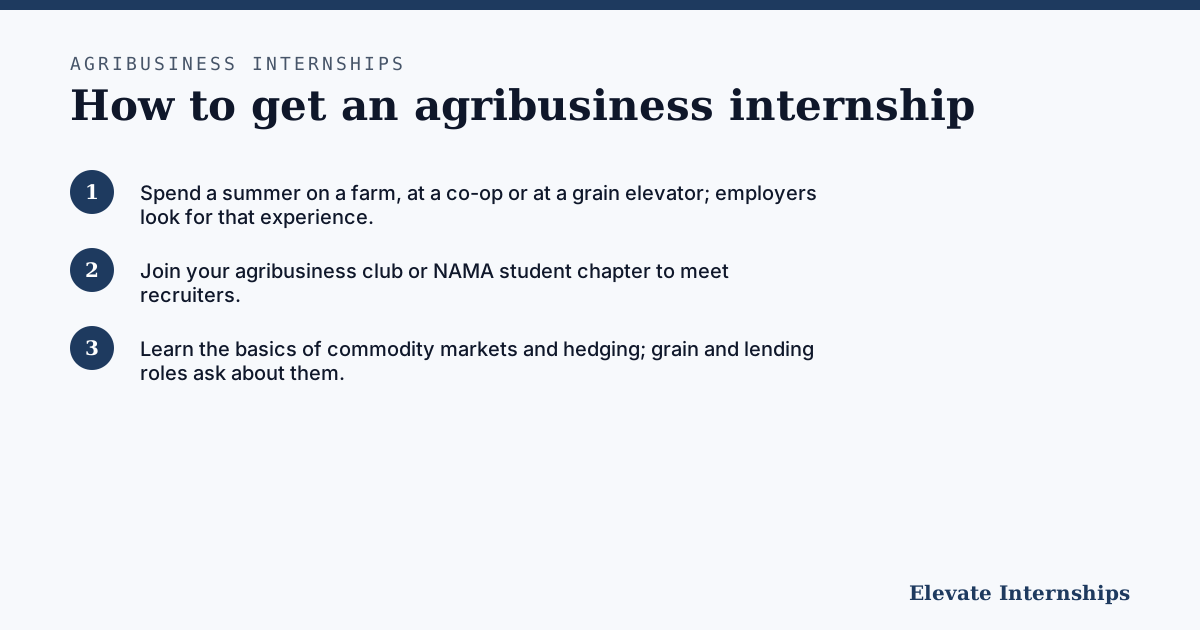
- Spend a summer on a farm, at a co-op or at a grain elevator; employers look for that experience.
- Join your agribusiness club or NAMA student chapter to meet recruiters.
- Learn the basics of commodity markets and hedging; grain and lending roles ask about them.
Find agribusiness internships near you →
More on this major: agribusiness internships, with recent listings and the questions students ask.